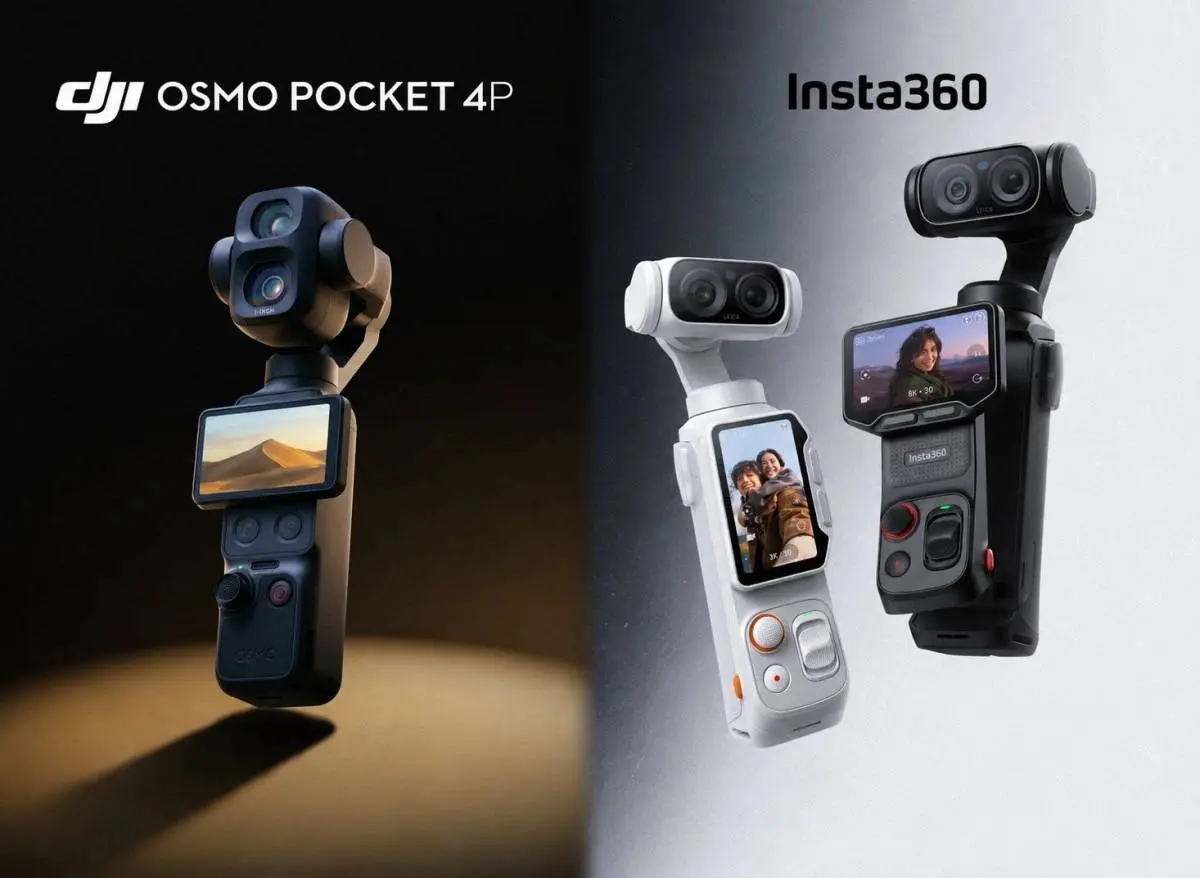
DJI has filed two simultaneous lawsuits against Insta360 in the US, days after Insta360 launched the Luna Ultra — a direct competitor to the Osmo Pocket 4P. The legal action covers both design patents and utility patents. DJI wants an injunction to stop Luna series sales in the US entirely.

The DJI Osmo Pocket 4
This is the second time DJI has sued Insta360 this year. The first was in China over alleged employee poaching and stolen drone R&D.
Key Points
- DJI filed two lawsuits against Insta360 in the US following the Insta360 Luna Ultra launch — one covering design patents, one covering four utility patents
- Design lawsuit: DJI claims the Luna series copies its Osmo Pocket design — specifically the elongated body, neck-to-gimbal connection, rotatable display, scroll wheel, record button, side accessory slot, and base port
- Utility lawsuit: four DJI patents cited — single-control gimbal mode switching, integrated subject tracking with on-device display, image-driven gimbal motor commands, and a self-contained subject tracking system
- DJI is seeking an injunction to halt Luna series sales in the US — the outcome depends on how courts assess design similarity and utility patent infringement
- Earlier in 2026, DJI sued Insta360 in China for allegedly poaching employees and using stolen R&D to file drone patents — now the conflict has expanded to the US camera market
The Design Case — Obvious Resemblance, Unclear Legal Outcome
Anyone who has seen both products side by side understands why DJI filed. The Luna Ultra and Osmo Pocket 4P share the same fundamental form factor — handheld gimbal camera with a rotating display, scroll wheel controls, bottom port, and side accessory slot. The resemblance is not subtle.

Whether resemblance becomes infringement in US patent court is a different question. Design patents protect ornamental appearance — the specific combination of visual elements in DJI's patents. Insta360 will argue its design choices were independently derived or insufficiently distinct from DJI's claims to constitute infringement. Courts have gone both ways on camera design patents historically.
DJI's specific patent language — covering the "neck connecting the body to the gimbal arm connection point" and the "rotatable display and bezel" separately from the "lower control section housing the scroll wheel and record button" — suggests DJI has been careful to file granular claims rather than one broad design assertion.
The Utility Case — Four Technical Patents
The utility lawsuit is potentially more consequential. Utility patents protect how something works, not how it looks — and four separate patents means four separate infringement arguments to defeat.
The most interesting patent is the second one: "a handheld gimbal with integrated subject tracking and real-time display, eliminating the need for a separate app." This directly describes one of the Pocket series' defining features — on-device tracking without a phone. If DJI holds that patent and it's valid, Insta360 faces a significant technical design challenge regardless of the lawsuit outcome.
The Broader Context
DJI and Insta360 have been escalating their rivalry across every product category. The action camera, 360-degree camera, and now handheld gimbal camera markets all feature head-to-head competition. DJI's China lawsuit earlier this year over drone patent theft — allegedly using former DJI employees' knowledge — signals the company is taking an aggressive legal posture rather than treating competition as routine.
The US filing specifically suggests DJI believes American courts offer better prospects for an injunction than Chinese courts. That calculus may be correct — US patent injunctions in technology cases have become harder to obtain in recent years, but design patent cases have seen notable wins.
Popular News

Latest News
Loading