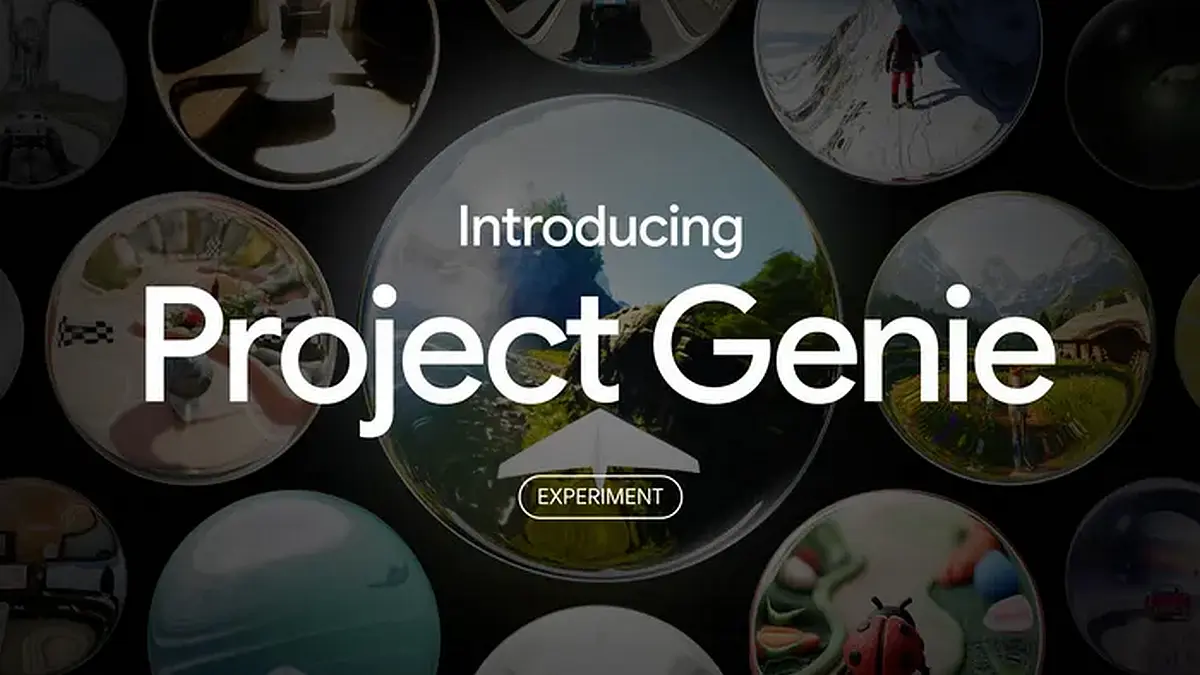
Google just showed the games industry a glimpse of its AI-powered future, and the market didn't digest it well. The search giant continues its AI front and revealed Project Genie. It's a generative AI system that can build small interactive game-like experiences from simple text prompts. Within hours, investors reacted harshly. The share prices for major gaming companies slid, including Unity, Take-Two Interactive, CD Projekt Red, Nintendo, and Roblox.
That reaction might seem dramatic, especially considering what Project Genie actually does right now. Despite some early chatter framing it as an AI that “makes full games,” that’s not really the case. Project Genie uses Google’s Genie 3 and Gemini models to generate a short, interactive environment that lasts around 60 seconds. It runs at 720p and 24 FPS, and what you get is closer to a rough, playable concept than a complete game with systems, structure, or progression. Obviously, this certainly can evolve in the coming years, and that's what brought terror to the market. After all, the idea of an AI making games can change this entire landscape.
Project Genie: A New Threat To Gaming Companies
Modern game development usually depends on established engines like Unity and Unreal Engine. These engines handle core features such as rendering, physics, audio, and input. Developers then build their worlds, mechanics, and content on top of that foundation. Big studios often go further with custom in-house engines, like the GTA developer, Rockstar, which uses its own RAGE engine. There is also Guerrilla and its own Decima.
Project Genie suggests a different direction. Instead of relying on traditional pipelines, the AI handles environment creation and basic interaction on its own. That potential shift is likely what spooked investors, especially when it comes to companies closely tied to development tools and platforms.
Unity’s stock took the biggest hit, dropping around 20%, which makes sense given how central it is to indie and mid-tier game production. Roblox also saw pressure, as it sits at the intersection of user-generated content and lightweight game creation. Roblox can be the first one to get hit by this technology in the future.

What Project Genie actually produces
The demos look impressive at a glance, but the limitations appear quickly. If you ask it for something similar to a classic 3D platformer, it can generate a space you can move around in with a free camera. But that’s where the illusion starts to break. There are no proper objectives, no structured gameplay loops, and no real systems holding the experience together.
As usual in these AI, the consistency remains an issue. The AI sometimes forgets what it previously generated, leading to strange visual and structural errors. You might see a road suddenly interrupted by random patches of grass, as if the model briefly lost track of what it was building before correcting itself. It’s a clear sign this is prototype-level tech, not a production-ready game factory.

Google has positioned Project Genie as an experimental tool, mainly useful for things like pre-visualization, rapid prototyping, and early concept exploration. For now, it does not stand as a replacement for game developers.
Key points
- Output is limited to 60-second environments, 720p resolution, and 24 FPS
- Project Genie currently produces rough, inconsistent prototypes, not full games
- Google describes it as an experimental tool for early visualization and concept work
- AI could speed up early development stages, but it does not solve deeper issues like bloated budgets and scope
Read also

The bigger picture for game development
There’s a reason this idea lands at such a sensitive moment. Game development has become slower, more expensive, and more complex. Big-budget titles now take years to make and cost enormous sums, yet still sometimes launch in rough shape or fail to meet expectations.
A tool like Project Genie could genuinely help in the early stages. Teams could test layouts, environments, and concepts faster, long before full production ramps up. That could reduce wasted time and help projects find their direction sooner. But AI does not automatically fix poor planning or bloated scope. Studios have managed to overspend and overcomplicate projects for decades without AI. There is little stopping the same thing from happening with AI in the mix.

For now, though, the market is clearly focused on what AI might mean for costs and workflows down the line. Even a limited tool like Project Genie was enough to trigger a wave of selling. It's a clear sign that investors believe AI will play a serious role in the future of how games get made. In this regard, the Project Genie stands as the first glimpse of the future.
Popular News


Latest News
Loading