The Only Charger Your Desk Needs: JOYROOM PODIX 140W Review
ReviewsWednesday, 25 February 2026 at 09:22
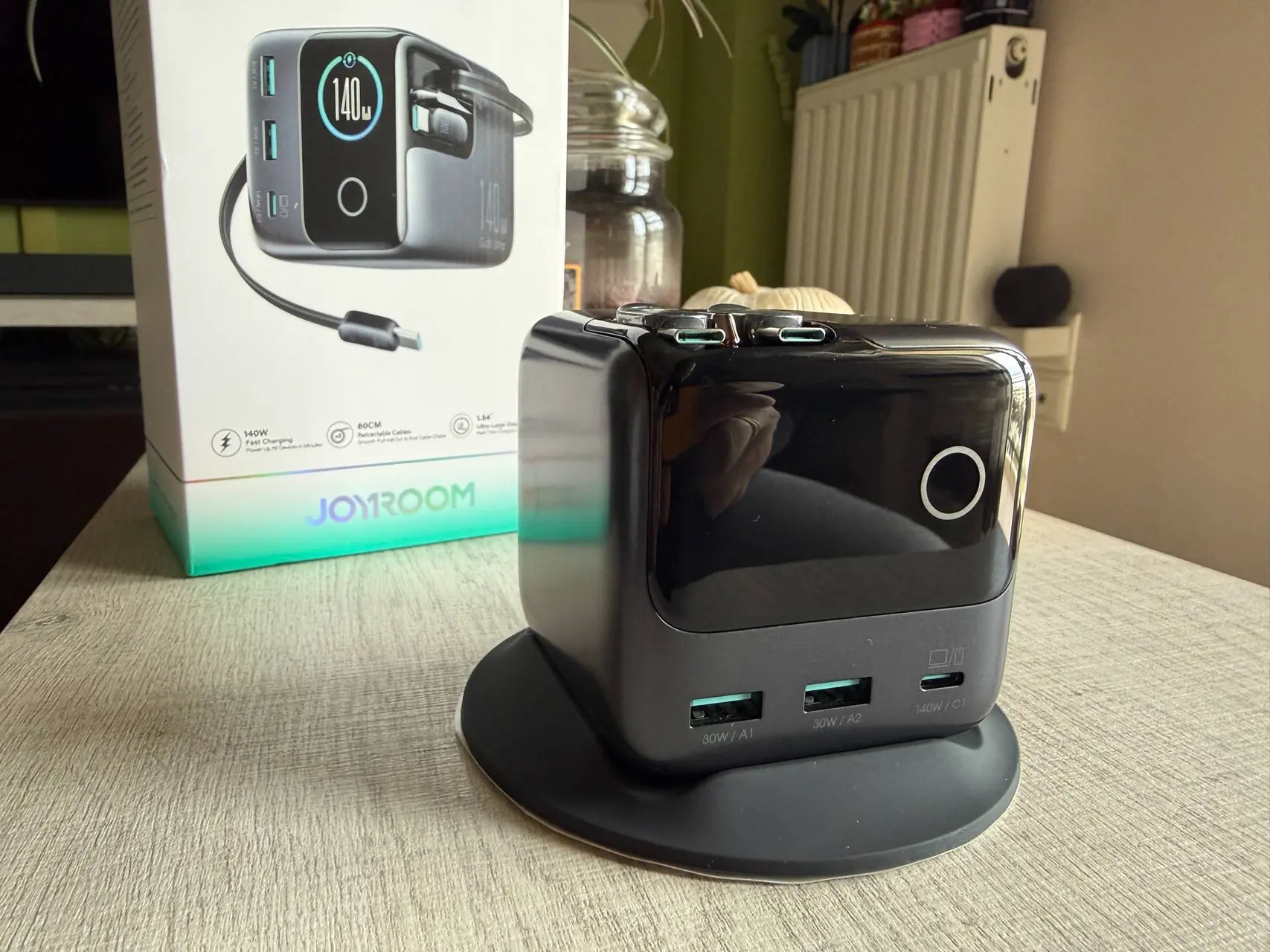
We have all been there—staring at a "cable jungle" on our desks, wondering which brick belongs to which device and why we never have enough outlets. The JOYROOM PODIX 140W 5-port GaN charger (model JR-TRD01) enters this chaotic scene not just as another power supply, but as a sophisticated "power dashboard" for your workspace. After spending some quality time with a review sample, it is clear that this device is designed for people who don't just want power; they want data and order.

Key Points
- Integrated Display: Features a 1.54-inch LCD for real-time total and per-port wattage monitoring.
- Cable Management: Built-in dual 80cm retractable 100W USB-C cables significantly reduce clutter.
- Smart Distribution: Intelligently manages 140W across 5 ports, supporting PD 3.1 and QC 3.0.
- Stable Design: A tri-magnetic base with 180-degree rotation allows for one-handed cable operation.
- Thermal Efficiency: Next-gen GaN technology ensures high-speed charging without overheating.

Unboxing and the "Magnetic" Personality
The PODIX arrives in a retail package that makes its intentions clear: fast charging, high-density power, and total desk integration. Inside, you find the 466-gram cube, a power cord (available in multiple regional variants), an anti-slip silicone pad, and a user manual.

The build quality is immediately impressive. It feels dense and durable, roughly the size of a standard Rubik’s cube. The design features a tri-magnetic base that pairs with the included silicone pad. This isn't just for show; it allows the charger to sit firmly while offering 180-degree rotation. Whether your laptop is on the left or your tablet is on the right, you can swivel the PODIX to face the action.

The true stars of the physical design are the dual 80cm retractable USB-C cables tucked into the top. These eliminate the need for extra cords for your most frequent devices. They are rated for 100W each and have been tested for over 10,000 bends, which should ease any anxiety about the longevity of a non-removable cable system.

Decoding the 140W Architecture
While the "140W" label is the headline, the magic lies in how the PODIX manages its five ports (3x USB-C and 2x USB-A). This charger utilizes PD 3.1 standards on its primary C1 port, allowing for a single-port output of 140W—enough to fast-charge a 16-inch MacBook Pro to 50% in under 30 minutes.

However, when you start plugging in more gear, the internal logic shifts. This is where you have to play a bit of "power Tetris." For instance, when all five ports are occupied, the distribution looks like this:
- USB-C1: 20W
- USB-C2: 20W
- USB-C3: 80W
- USB-A1 + A2: 15W (shared)
It is slightly counter-intuitive that the C3 port (the bottom-most front port) retains the highest wattage (80W) in a full-load scenario while the retractable cables drop to 20W. Understanding this hierarchy is vital for anyone trying to charge a laptop and four accessories simultaneously.

The 1.54-inch "Brain" on the Front
The standout feature is undoubtedly the 1.54-inch LCD display. In an industry where most chargers are silent, black bricks, the PODIX talks back. It provides a real-time visualization of your power consumption. You can toggle through three distinct modes using the control button:

- Total Output Mode: Shows the combined wattage of all connected devices.
- Per-Port Mode: A granular look at exactly how many watts each individual port is pushing.
- Emoji Mode: An animated UI that displays bubbles, fireworks, or a happy face. While purely aesthetic, it adds a bit of personality to an otherwise utilitarian tool.

During testing, I noticed a "delta" between the PODIX’s readings and a dedicated wall power meter. For example, during a laptop stress test, the PODIX reported 36W while the wall meter showed 41.6W. This ~5W difference is largely due to the conversion efficiency of the GaN circuitry—power lost as heat before it ever reaches the cable. For most users, a 1W-resolution display is more than enough for troubleshooting or monitoring battery health.

Real-World Stress Testing: Five Devices, One Cube
To truly put the GaN technology to the test, I connected a demanding ecosystem: a laptop (65W target), a Raspberry Pi 5, a portable HDMI monitor, a wireless display (Eazeye Radiant), and a smartphone.

The initial setup was a bit rocky. The wireless display, connected via USB-A, began to flicker and disconnect. By checking the per-port display, I realized the A-ports were sharing 15W, which was being overdrawn by the combination of the display and the phone. After a quick "reorganization"—moving the power-hungry wireless display to the C1 port (which offers 20W in multi-mode)—everything stabilized perfectly.

The Raspberry Pi 5 presented another interesting case. While the Pi 5 ideally wants a 5V/5A (25W) supply for full peripheral support, the PODIX’s smart recognition kept it running smoothly, though the display reported a surprisingly low 3W during some idle periods. This highlights that while the meter is incredibly useful for high-wattage tracking, its precision at the very low end of the spectrum may vary.
Efficiency and Thermal Management
Thanks to Gallium Nitride (GaN) technology, the PODIX remains remarkably cool compared to traditional silicon-based chargers. Even when pushing nearly 83W at the wall for extended periods, the casing was only warm to the touch, never hot. This efficiency is why the PODIX can be so small while offering five ports and a screen. It also features eight layers of safety protection, covering everything from over-voltage to short-circuit prevention.
Final Verdict: The Reviewer's Best Friend?
The JOYROOM PODIX 140W is a specialized beast. At its current price it is more expensive than a basic multi-port brick, but you are paying for the integration. The combination of retractable cables, a rotatable magnetic base, and a real-time power meter makes it an invaluable tool for developers, tech reviewers, or anyone managing a complex "SBC" (Single Board Computer) lab.
If you are ready to upgrade your desk setup, the JOYROOM PODIX 140W is readily available across major platforms. For users located in the United States, the fastest shipping and best local support can be found on Amazon US. For those residing in Europe, Asia, or other regions, the official JOYROOM store offers direct international shipping to ensure you can access this high-performance hub regardless of your location.
Popular News



Latest News
Loading