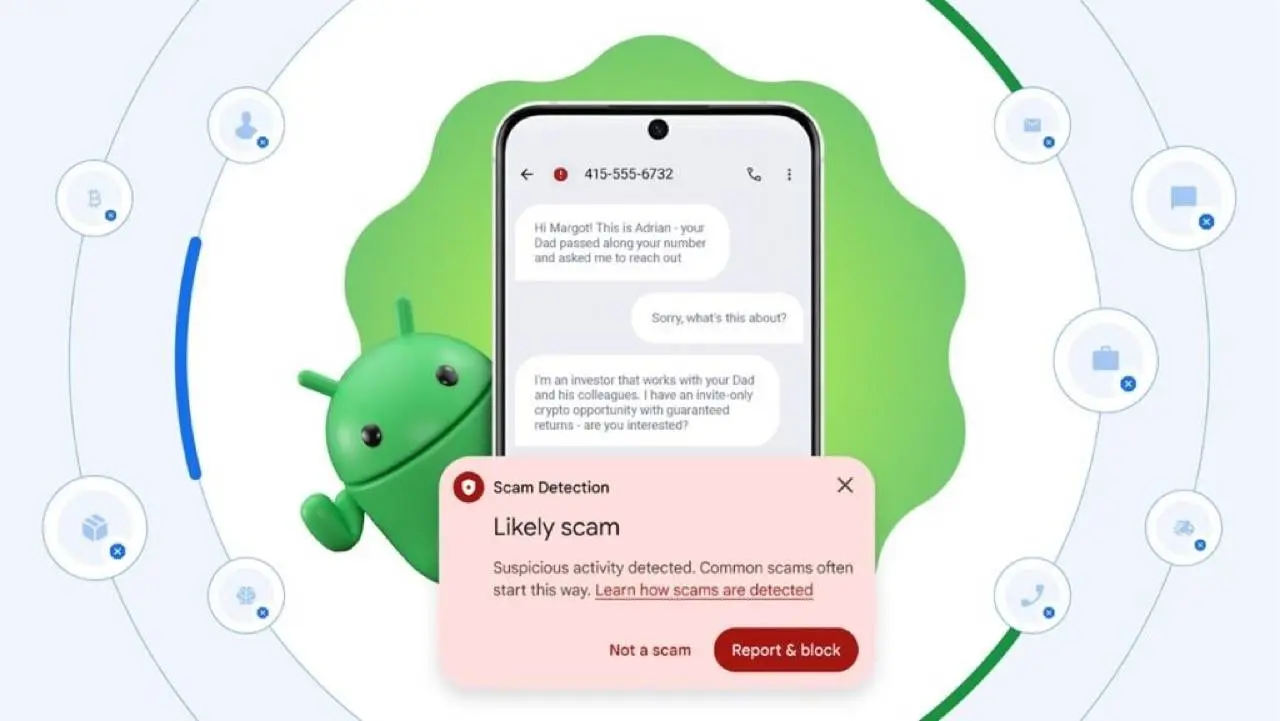
As Cybersecurity Awareness Month wrappped up, Google has shared a telling snapshot of how Android’s security tools are stacking up against one of today’s most relentless digital threats — mobile scams. With global losses from online fraud surpassing $400 billion last year, the company’s findings highlight how Android’s AI-driven defenses may be giving its users a real advantage.
Android’s Quiet Advantage Against Scams
Every month, Android systems intercept over 10 billion suspicious calls and messages before they ever reach users. Google’s RCS (Rich Communication Services) checks also block fraudulent numbers by the hundred million — more than 100 million just last month, according to the company.

It’s a scale of protection that has quietly become one of Android’s strongest selling points. While Apple has leaned on privacy and ecosystem control, Google has taken a more active, defensive stance — embedding AI models that continuously learn from scam trends in real time.
The Survey: Android Users Feel Safer
To understand how people actually experience these protections, Google teamed up with YouGov to survey 5,000 smartphone users in the U.S., India, and Brazil. The results paint a pretty clear picture:
- Android users were 58% more likely than iPhone users to say they hadn’t received a single scam text in the previous week.
- Pixel owners topped the chart — 96% more likely than iPhone users to report zero scam texts.
- iOS users, on the other hand, were 65% more likely to have received three or more scam texts in a week.
- Android users were 20% more likely to describe their phone’s scam protection as “very effective” or “extremely effective.”
- Perhaps most strikingly, iPhone owners were 150% more likely to say their phone failed to stop a scam or fraud attempt.
That’s not a small perception gap — it suggests that Android users not only face fewer scams, but also feel more confident in the system guarding them.

Independent Tests Back the Findings
It’s not just user opinion. Research from Counterpoint and Leviathan Security Group found similar results after independent testing of Android and iOS devices. Counterpoint’s study showed Android employing AI-based defenses across ten protection categories, from message scanning to behavioral threat detection. iOS, by contrast, used AI in just two.
Leviathan’s comparative test — using the iPhone 17, Pixel 10 Pro, Moto Razr+ 2025, and Galaxy Z Fold 7 — reached an even clearer verdict: Android devices, especially the Pixel 10 Pro, offered the strongest default protection against scams and fraud.
Among the standout tools:
- On-device call screening that can detect and block scams in real time.
- AI-based warnings when users attempt risky actions, such as installing unverified apps.
- Automatic authentication alerts if a caller or message looks suspicious.
These layers work locally, meaning your phone does the thinking without sending your call data to the cloud — a subtle but important privacy distinction.

How Android’s AI Keeps Users Safe
Google’s anti-scam strategy isn’t one feature — it’s an ecosystem. Each layer plays a different defensive role:
Messages:
Spam texts are automatically filtered into a blocked folder, and the system flags scam-like language patterns using on-device AI. If an unknown number tries to mimic a known scam format, Android can flash an instant warning before you even open the message.
Calls:
The Phone by Google app can screen suspicious numbers before they ring. For unknown callers, Call Screen answers on your behalf and transcribes the call live, showing you whether it’s legitimate or a potential fraud attempt.
Apps & Web:
Meanwhile, Play Protect constantly scans installed apps for risky behavior, while Chrome’s Safe Browsing, now powered by large language models, flags malicious sites and downloads before damage is done.
It’s a multi-layered web of protections designed not just to react — but to anticipate.

The Bigger Picture
There’s a broader story here: as scams grow smarter, Android’s security is evolving in kind. Google’s approach is to let AI do the heavy lifting quietly in the background — not just blocking links, but understanding patterns in speech, writing, and behavior.
It’s easy to overlook, but for the average user, these subtle defenses are now as important as camera specs or display refresh rates. You might never notice them working — and that’s the point.

Key Takeaways
- Android users were 58% less likely than iPhone users to receive scam texts.
- Google’s systems block 10 billion+ scam calls and messages monthly.
- Pixel 10 Pro led independent tests for scam and fraud protection.
- Android uses AI in 10 protection areas, versus two on iOS.
- Features like Call Screen and Play Protect create a proactive safety net.
Popular News




Latest News
Loading