OpenAI Launches ChatGPT Health: Personal Data Integration Details
ChatGPTThursday, 08 January 2026 at 08:57
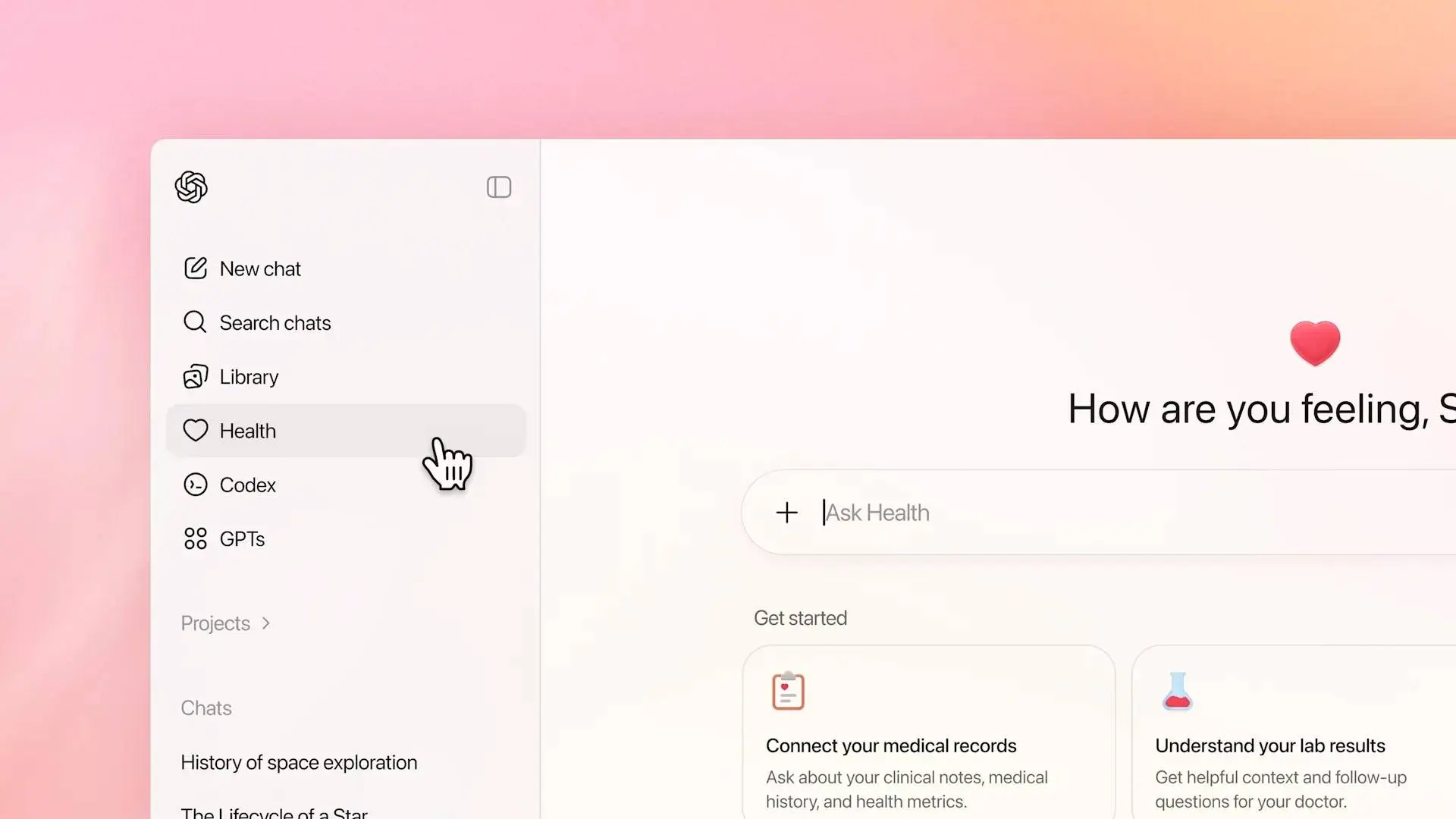
OpenAI confirmed the launch of ChatGPT Health on January 7, 2026, as a dedicated, sandboxed environment within its main platform. The company cites internal data showing that roughly 230 million people globally already use the chatbot for wellness queries. This new space is designed to formalize that usage by providing an encrypted "silo" where personal biometrics and medical history can live without leaking into general chat logs.

Wearable and Wellness Syncing
The "Health" sidebar option allows users to connect various third-party ecosystems directly to the AI model.
- Apple Health: Users on iOS can pull in heart rate, sleep cycles, and step counts.
- MyFitnessPal: Provides the model with real-time calorie and macro-nutrient tracking.
- Additional Apps: Support includes Peloton for workout intensity, AllTrails for outdoor activity, and Instacart for nutrition-based grocery lists.
- Function & Weight Watchers: These integrations offer specialized oversight for blood lab insights and GLP-1 medication management.

The US-Only Clinical Layer
For users in the United States, OpenAI has partnered with b.well Connected Health.
- EHR Integration: This allows ChatGPT to access actual electronic health records from thousands of providers.
- Lab Reports: The AI is tuned to explain "out-of-range" markers in bloodwork and summarize years of clinical notes for an upcoming appointment.
- HealthBench: OpenAI utilized over 260 physicians and 600,000 clinical feedback points to verify the model’s safety and "escalation of care" logic.
Privacy and Geographic Guardrails
OpenAI is emphasizing a "one-way wall" for data security.
- No Training: Data processed inside the Health silo is strictly not used for training foundation models like GPT-5.
- Isolation: Health "memories" do not flow back into standard chats, though standard chats can sometimes provide context to Health (e.g., "I just moved to a high-altitude city").
- Restrictions: Due to regulatory barriers, the feature is currently blocked in the UK, Switzerland, and the European Economic Area (EEA).
Technical Limitations
Despite the clinical branding, OpenAI maintains that this is not a diagnostic tool. It is an "assistant" meant to summarize data so users feel more prepared for doctor visits. It operates on a waitlist basis for Free, Go, Plus, and Pro tiers, excluding the restricted regions mentioned above.
Popular News


Latest News
Loading