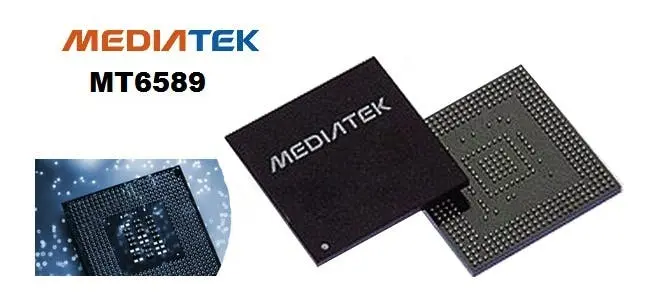
Many of you will already know that Taiwanese Semi-Conductor manufacturer Mediatek have announced their MT6589 Quad core processor. Mediatek have usually focused on low-end chips but are now looking to change that with the MT6589. In this article I’m going to go over the specifications and features of this processor.
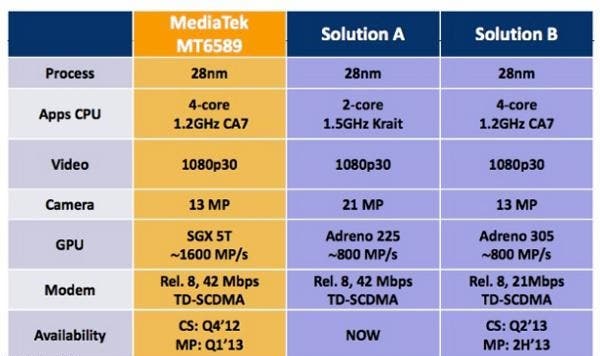
The MT6589 is a quad-core Cortex A7 1.2GHz CPU. The MT6589 is different to rival quad-core chips from Qualcomm, Nvidia and others because this processor combines an ARM CPU, a PowerVR Series 5XT GPU and a wireless modem chip onboard. Unlike previous chips from mediatek, the MT6589 supports hardware that is only just starting to come out in high-end phones today. The MT6589, thanks to the PowerVR GPU can support up to 1080p Full HD screens. It also supports up to 13MP cameras with integrated ISP, 1080p playback and recording at 30fps, and enhanced image processing for DTV-grade image quality . Not just this but the GPU is powerful enough to support 3D, including real-time 2D to 3D conversion and support for 3D displays.
Like I mentioned earlier, the processor not only has an integrated graphics chip, it also has an integrated wireless modem as well. It has a 42Mbps DC-HSPA+ / TD-SCDMA-capable dual-SIM dual-active radio. This means that it will support 3G speeds of up to 42Mbps. Many networks have started upgrading their 3G networks to support DC-HSPA+ so this modem will be able to support these much faster speeds unlike the MT6577 which was bottlenecked to just 7.2mbps download speed. As mentioned the processor will also support dual sim cards which is a huge plus. A neat new feature is that the processor now has a dual active radio. What this means is that when you take a call on one sim card, the other sim card is still active and can accept or make calls as well. This is something that was lacking from previous Mediatek Processors.
The MTK6589 also supports Miracast technology for multi-screen content sharing and pre-integrates MediaTek's leading 4-in-1 connectivity combo, which supports 802.11n Wi-Fi, BT4.0, GPS and FM Radio. The good news here is the upgraded version of Bluetooth, Wi-Fi on the N band and the fact that the processor supports multi screen output.
So as you can see the Mediatek MT6589 is a very powerful CPU. However it’s all good and well having a powerful CPU but it’s worthless if it is not efficient as it would just overheat and drain the battery. You will be glad to hear that MT6589 is the most power efficient and coolest Quad core processor on the market. You can take a look at the video below for proof. Another great feature about the MT6589 is that it is very cheap to produce. So we should see it in a lot of low-cost/budget devices just like we did with the MT6577.
The MT6589 benchmarks at 13500+ with Antutu on most devices. The Dual core Qualcomm S4 and Mediatek MT6577 benchmark at around 9000 and 5500 respectively. From this we can see that the MT6589 benchmarks better than Dual core processors out today, when compared to Quad core processors it’s narrowly beaten by the Nvidia Tegra 3 processor with a score of 15000. However, Antutu scores are never a true reflection on real life performance. IMO the MT6577 performs just as well in some areas compared to other dual core processors that score higher scores. So I would expect the MT6589 to be the same.
As you’ve all probably seen from GizChina’s front page, the MT6589 will be making it’s way to a huge number of manufacturers this year and not just domestic brands like Jiayu and THL. Sony, Lenovo, Huawei, ZTE and many others have expressed their interest in the processor for their new budget Quad core phones. We can expect to see the MT6589 in phones before the end of Q1.
Tip: Be wary of online retailers claiming different from above. For example with the MT6577 many online sellers provided false specs claiming that the camera was better megapixels than the processor supported. Other online sellers claimed that the MT6577 was clocked at 2.0GHz and not 1.0GHz. So make sure to refer to this article when choosing a MT6589 phone to get the correct max specifications. So If you see an advertisement saying 16mp camera, it is going to be a 13mp camera max which has been interpolated to support 16mp resolutions.
Popular News


Latest News
Loading