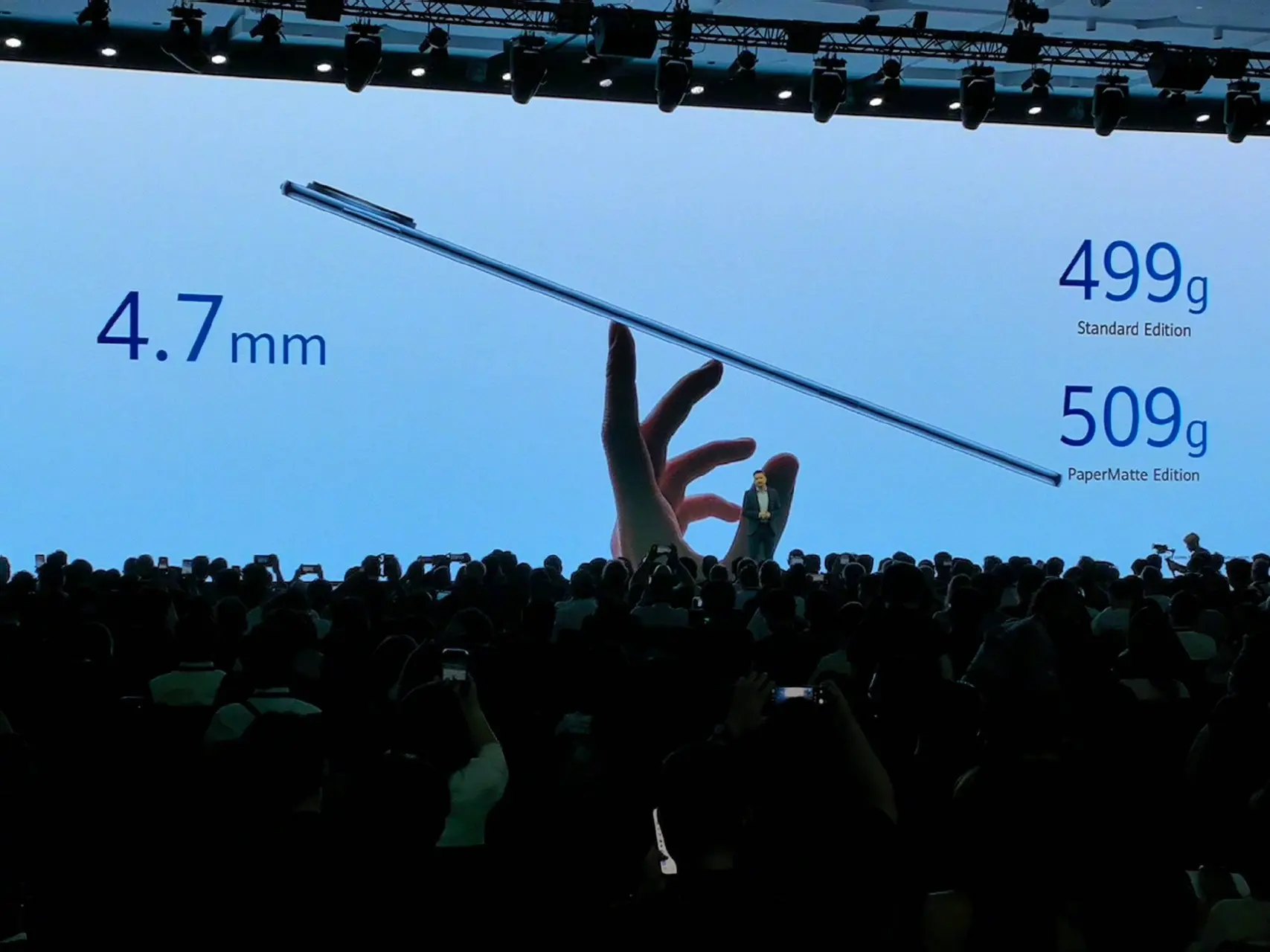
At 4.7mm, it is thinner than your thumb. It also carries a 10,400mAh battery. Those two facts don't usually share the same sentence.
Summary
- The Huawei MatePad Pro Max launched globally at Huawei's "Now Is Your Spark" event in Bangkok on May 7, 2026, confirmed as the world's thinnest and lightest 13-inch+ tablet at 4.7mm and 499 grams — thinner than Apple's 13-inch iPad Pro M5 at 5.1mm.
- The 13.2-inch flexible OLED panel runs at 3K (3000x2000) resolution, 144Hz refresh rate, 1,600 nits peak brightness, 1440Hz PWM dimming for eye comfort, and 3.55mm ultra-thin bezels — with the front camera hidden entirely within the bezel.
- A 10,400mAh battery with 66W fast charging and 40W reverse wired charging powers the device — a remarkable capacity for a 4.7mm chassis, enabled by Huawei's Cloud Falcon Architecture and silicon-carbon cell technology.
- The Kirin 9-series chipset delivers a claimed 20% performance boost over the previous generation, paired with 12GB RAM and up to 512GB storage, a dual-layer VC cooling system with 100% larger heat dissipation area, six speakers, and a 50MP rear camera.
- The tablet is available in standard (499g) and PaperMatte Edition (509g, anti-glare nano-etched display) in Shimmery Blue and Space Gray — the first tablet to receive TÜV Rheinland Ultra-thin Bending Resistance Certification.

"Android Central's reviewer put it plainly after handling the device: 'It didn't really feel like I was using a 13-inch tablet with a 10,400mAh battery.' That reaction — genuine surprise at the weight and thinness — is the best proof-of-concept for what Huawei achieved with the MatePad Pro Max."
The Engineering Story Behind 4.7mm
Getting 4.7mm across a 13.2-inch flexible OLED with a 10,400mAh battery requires rethinking how every component sits inside the chassis. Huawei's Cloud Falcon Architecture refers to a structural design that redistributes internal component placement — moving away from traditional stacking toward a flatter arrangement that allows the overall body to shrink while battery volume is preserved. The dual-layer VC cooling system with 100% larger heat dissipation area compared to the previous MatePad Pro keeps the Kirin 9-series chip from throttling despite the reduced thermal headroom.
The TÜV Rheinland Ultra-thin Bending Resistance Certification is the external validator. It confirms that the 4.7mm chassis doesn't sacrifice structural integrity — the tablet resists bending and flex at a level 60% higher than the previous generation. That matters for a device this thin. Users who flex it carrying it in a bag or pressing on the screen edge need confidence it won't develop stress fractures.
The Display Is the Easy Win
A 13.2-inch flexible OLED at 3K resolution with 3.55mm bezels and a hidden front camera is as good a display specification as exists in the tablet market right now. The 1440Hz PWM dimming is the eye comfort detail that matters most for productivity users — it eliminates the flicker that causes headaches during extended sessions at lower brightness settings. At 1,600 nits peak, outdoor visibility is genuinely usable. The PaperMatte Edition's nano-etched anti-glare surface adds a paper-like texture that reduces reflection further, at the cost of 10 additional grams.
The Productivity Pitch
HarmonyOS 4.3's Live Multitask feature allows three apps open simultaneously in a side-by-side comparison layout — a workflow feature that targets the buyer replacing a laptop. The Glide keyboard accessory, PC-level WPS Office AI integration, and the GoPaint creative tools complete the productivity stack. This is explicitly a laptop replacement pitch, not a media consumption device. The 6-speaker array and four microphones support that positioning for video calls and content creation work.
Popular News

Latest News
Loading