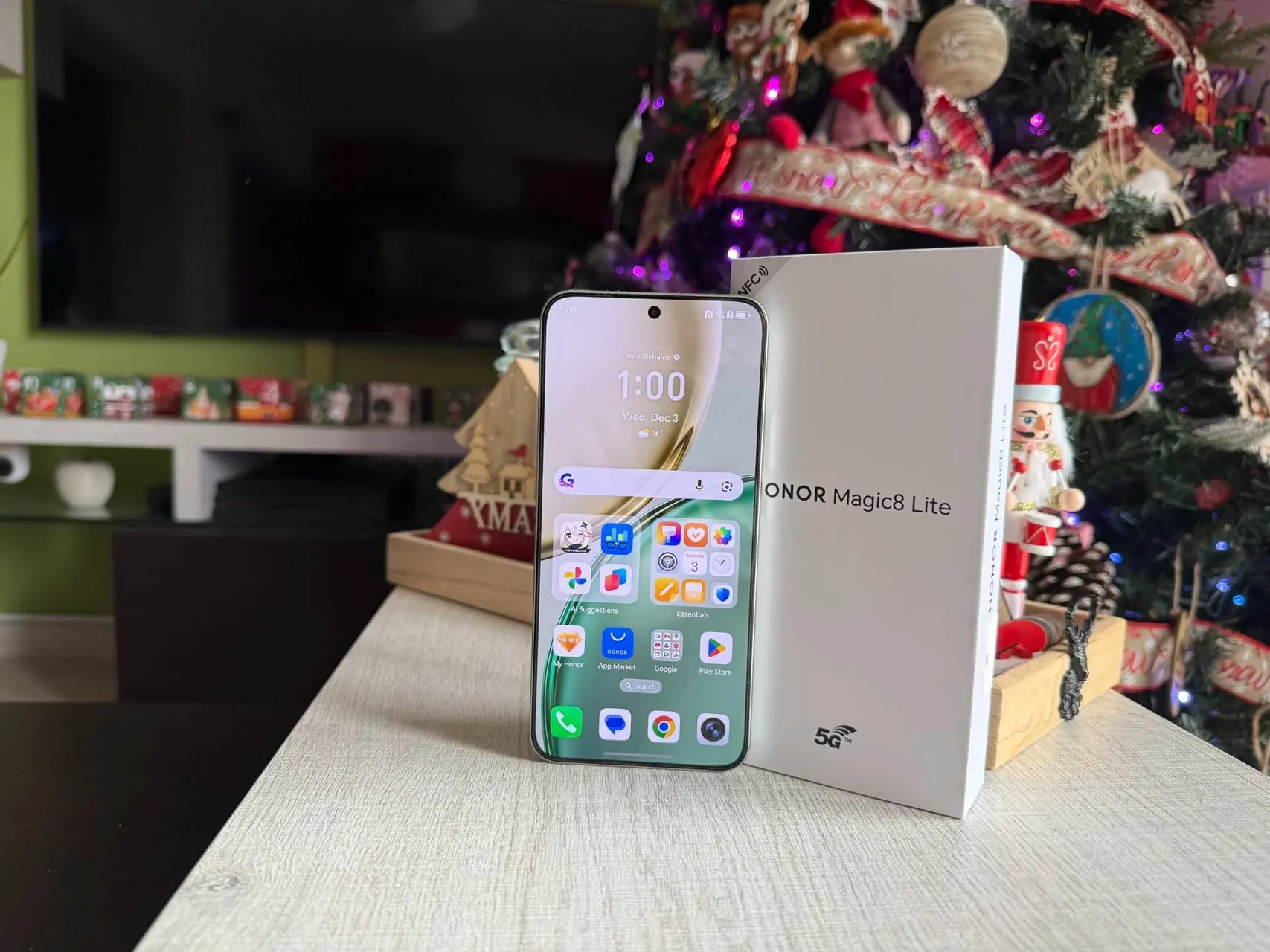
I've tested a lot of phones over the years—hundreds, actually—and you quickly learn where to expect trade-offs. It's the nature of the mid-range beast: you pay less, you get less. Usually, that means a sacrifice in camera quality, or maybe a slightly dimmer screen, or perhaps a plastic build that feels a bit... well, cheap. What you don't expect is a phone that utterly rewrites the rules for battery life while simultaneously feeling like a genuine fortress in your hand. But here we are, staring down the Honor Magic 8 Lite, a device that is, frankly, baffling in its priorities.

If your primary anxiety in life is watching that battery percentage tick down, then stop reading right now. Go buy this phone. Seriously. I’ve never used anything quite like it. Four days on a single charge? That's not a boast from the marketing department; that's just... what it does. However, for those of us who also enjoy, you know, taking a decent picture or playing a visually demanding game without major stutters, the conversation gets a little more complex. This phone is an undisputed endurance champion, a marathon runner in a world of sprinters, but it certainly isn't a total home run.

Key Points:
- The 7,500 mAh silicon-carbon battery delivers an industry-leading, easy four-day battery life for typical users.
- It features exceptional durability, including an IP69K rating and 2.5m drop resistance, which is rare in its class.
- The 6.79-inch 120Hz OLED display offers high 6,000-nit peak brightness and eye-friendly 3,840Hz PWM dimming.
- Performance is powered by the Snapdragon 6 Gen 4, adequate for daily use but limited for high-end mobile gaming.
- The camera setup is a weak point, with a disappointing 5MP ultra-wide and only average performance from the 108MP main sensor.

Honor Magic 8 Lite - Main technical specs
- Dimensions - 161.9 x 76.1 x 7.76mm
- Weight - 189g
- OS - MagicOS 9, based on Android 15
- Display - 6.79-inch OLED, 120Hz
- Resolution - 2640 x 1200 pixels
- Chipset - Qualcomm Snapdragon 6 Gen 4
- RAM - 8GB
- Storage - 256GB / 512GB
- Battery - 7500mAh
- Rear cameras - 108MP (f/1.75) main, 5MP (f/2.2) ultra-wide
- Front Camera - 16MP (f/2.45)

The Core Contradiction: Unmatched Power Meets Mid-Range Hesitation
The headline feature, the great white whale of modern smartphone use, is the 7,500 mAh silicon-carbon battery. It's an absolutely massive cell, the kind you usually only see in true power-user or specialised gaming handsets. Honor paired this behemoth with the lower-power, yet still perfectly competent, Qualcomm Snapdragon 6 Gen 4 chipset.

The result of this combination is a synergy that delivers a runtime that should genuinely worry the competition. I managed a comfortable four days with what I’d consider light-to-moderate use—a few hours of social scrolling, emails, some music playback. Even if you're a heavy user, constantly watching video or navigating with GPS, I'd bet you'll clear two days without breaking a sweat. It changes the psychology of phone ownership entirely. You simply stop worrying about where the next charger is, and honestly, that’s a luxury usually reserved for the most expensive flagships.
And when you finally do need to top it up, the 66W wired charging is adequately speedy, getting you to 50% in about half an hour. It’s a slight annoyance, I think, that you don’t get the charger in the box—it’s 2025, I know, but for a phone in this price bracket, it feels like a slight stumble on value.
Display: A Bright Spot in the Mid-Range
Moving beyond the battery, the 6.79-inch OLED display is really quite lovely. Honor didn't skimp here, which is a pleasant surprise. The shift from the previous generation's curved edges to a completely flat screen is a sensible, practical decision. It removes accidental edge touches and, crucially, makes screen protector application much less of a headache.

The visuals themselves are excellent. OLED means deep blacks and vibrant colours, as expected, but the 120Hz refresh rate keeps all your scrolling and animations feeling slick. Perhaps more important for a lot of users is the 3,840Hz high-frequency PWM dimming. This might sound like technical jargon, but it basically means that for those of us sensitive to screen flickering at low brightness (which causes eye strain), this phone is a godsend. It's an eye-comfort feature that, surprisingly, is often overlooked by rivals. Plus, the 6,000-nit peak brightness is almost comically high—you will never struggle to see this screen outdoors, even on the sunniest day.
Design and Durability: The Hidden Fortress
Honor has truly beefed up the durability this year. It's an area where the Magic 8 Lite punches well above its expected weight class. It sports a top-tier IP68/IP69K rating for dust and water resistance. I mean, an IP69K rating—that’s for protection against high-pressure, high-temperature jets of water. This is usually reserved for industrial equipment or the most rugged of devices. You can absolutely take this thing into the shower for scrolling, or even drop it in a puddle, and it'll shrug it off.

The overall design has been modernised, too. The switch to flat side-rails gives the phone a more contemporary, perhaps 'flagship-lite' feel, even if the frame remains plastic. My Forest Green unit has a pleasant, velvety matte finish that resists fingerprints beautifully. Honor is also talking up their new 6-layer drop-resistant structure, which allegedly can survive drops from up to 2.5 meters. While I wasn't brave enough to test that claim on a marble floor, the phone certainly feels solid, a welcome assurance that you don't need a bulky case just to survive a minor tumble.

Performance and Software: Where Realism Sets In
Under the hood is the Snapdragon 6 Gen 4 SoC, paired with 8GB of RAM. The performance is, well, adequate. For day-to-day tasks—messaging, watching YouTube, hopping between apps—it’s perfectly fine. You might see a slight hesitation or a barely-perceptible stutter in system animations now and again. It’s not the buttery-smooth experience of a top-tier Snapdragon chip, but it absolutely gets the job done for the average user.
Where the limitation becomes noticeable is in gaming. I tried to push it with a few graphics-intensive titles. It runs them, sure, but you'll be locked into the lowest or maybe medium settings to keep a playable frame rate. If you're a casual gamer who sticks to less demanding titles, you won't care. If you want a gaming machine, this is not it. The battery is big, but the engine isn't fast enough for that kind of persistent, high-demand work.
The software, MagicOS 9, based on an older version of Android (Android 15), is where things get a bit messy. It's heavily customised, which will put off Android purists, but I personally found some of Honor's AI-driven additions quite useful. The Magic Portal, which lets you drag and drop text or images between apps easily, is genuinely a nice productivity boost.

It even has a Magic Pill feature, functionally similar to Apple's Dynamic Island, that gives you quick access to timers or media controls. It’s clever, but I did have to dive into settings to adjust the aggressive power-saving mode that, by default, sometimes delayed my important app notifications. That's a small but annoying quirk that definitely needs fixing. The promise of six years of software and security updates in the EU is great, though—a real commitment to longevity.

The Camera: An Area of Unchanged Compromise
Here's the honest truth: the camera hardware hasn't really changed for a few generations on the Magic Lite series, and it shows. The rear setup features a large 108MP main sensor and a paltry 5MP ultra-wide.
The main camera can take a good photo. In bright daylight, you get sharp, detailed 12MP shots (thanks to pixel binning), and Honor's processing, though a touch punchy for my personal taste, creates images that are ready for social media. Don't be fooled by the 108-megapixel number, though; trying to shoot in full resolution is often a mess unless the lighting is absolutely perfect, and forget about usable digital zoom past 3x. The quality falls off a cliff.
The ultra-wide lens, at 5MP, is the biggest let-down. It produces soft, low-detail images that you'll want to avoid in anything less than perfect, sunny conditions. It's a lens that's there more for specification sheet filler than actual utility.
The 16MP selfie camera is equally unremarkable—fine for a quick snap, but the portrait mode struggled with hair cutouts, and there's a frustrating lack of control, like being unable to adjust the background blur level. Video capabilities top out at 4K/30fps on the main lens, but the video stabilisation isn't the best, and the lack of consistency across the different lenses makes it a non-starter for anyone serious about content creation.

For a phone that excels in durability and longevity, the camera is the clear, lingering compromise. It makes you wonder what could have been if Honor had simply diverted some of that battery budget into a better ultra-wide sensor.

Final Verdict: It’s a Niche, But a Deep One
The Honor Magic 8 Lite is a genuinely unique mid-range phone. It creates a deep, powerful niche for itself: the user who prioritises battery life and durability over almost everything else. If you are constantly on the move, hate carrying power banks, and need a phone that can withstand a lot of physical abuse, this is perhaps the best value proposition on the market right now.
But I have to be clear: the performance is just fine, and the camera experience is a real downgrade compared to similarly priced rivals like the Samsung Galaxy A56 or Google Pixel 9a. This phone isn't for the mobile photographer or the avid gamer. It’s for the pragmatist, the professional, or the student who needs their device to last from Monday morning until Thursday evening without fail. It’s a testament to endurance, a phone that sacrifices a bit of sparkle for unparalleled stamina. And for many people, I think that trade-off will be worth every penny.
Popular News

Latest News
Loading