I Flew the World’s First 360 Drone, and Now Everything Else Feels Limited
ReviewsMonday, 09 March 2026 at 13:35
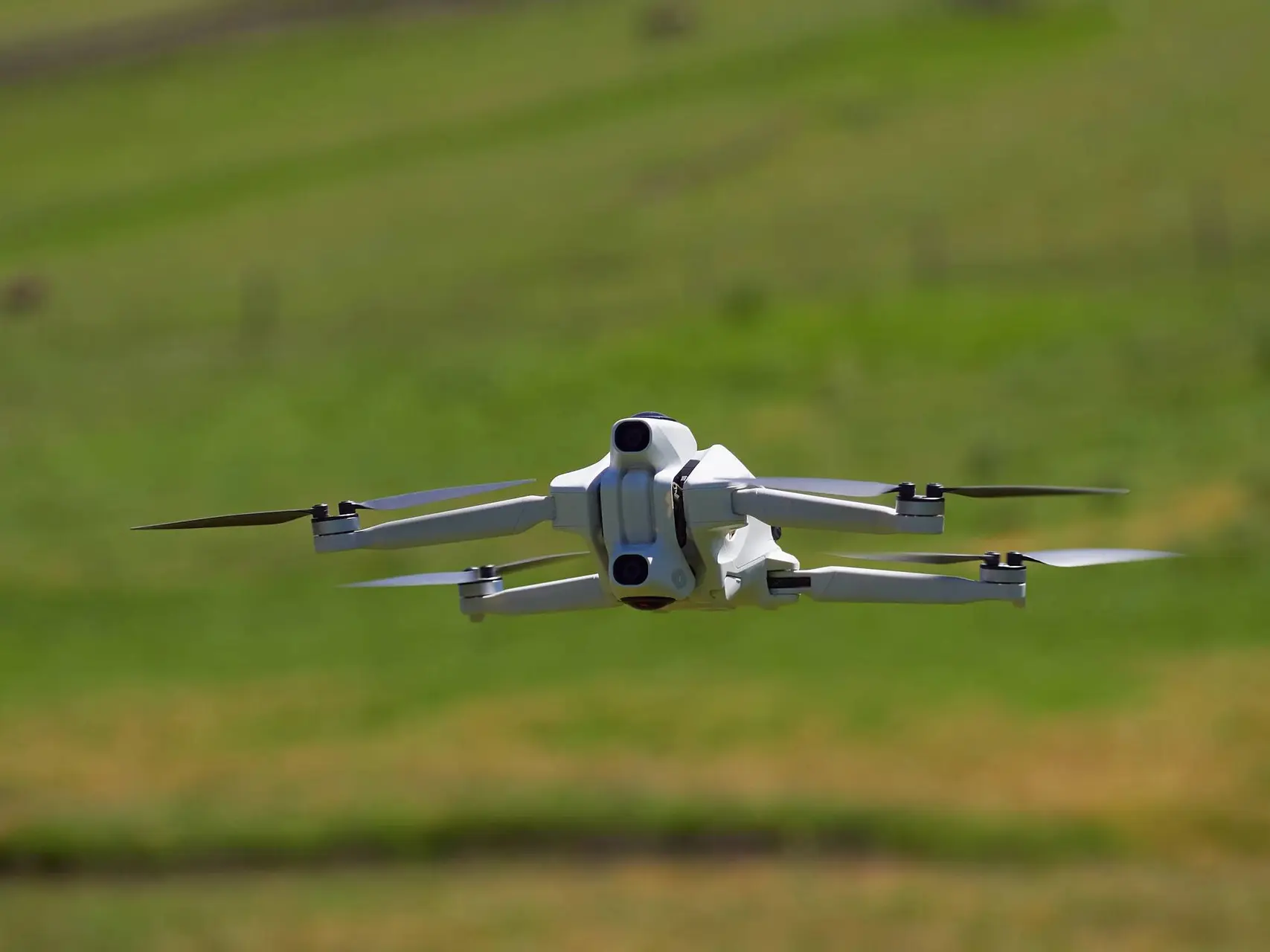
The drone industry has long been defined by a specific set of boundaries. You either have the traditional "flying tripod" used for cinematic landscapes, the frantic and immersive "First-Person View" (FPV) racer, or the AI-driven "follow-me" companion. Rarely do these worlds overlap in a way that feels cohesive. The Antigravity A1 represents a fundamental shift in this paradigm by introducing 360-degree capture to the skies. It is a device that does not just record what is in front of it; it records everything, everywhere, all at once.

Key Points
- Total Coverage: Dual-lens 360 camera records everything, allowing for total reframing in post-production.
- Legal Advantage: The sub-250g weight allows for more flexible flight in restricted regions.
- Immersive View: Vision goggles with motion-tracking allow the pilot to "look around" the sky in real-time.
- Smart Design: Motorized landing legs automatically fold out of the camera's field of view after takeoff.
- Professional Software: Utilizes industry-leading stitching and editing tools for seamless 8K video output.

Antigravity A1 — Specs
- Weight: 249g (Standard) / 291g (High-Capacity battery)
- Dimensions (Folded): 141.3 × 96.2 × 81.4 mm
- Dimensions (Unfolded): 308.6 × 382.3 × 89.2 mm
- EU Class: C0 (Standard) / C1 (High-Capacity)
- Flight Time: 24 min / 39 min
- Max Distance: 13 km / 23 km
- Max Speed: 16 m/s (35.8 mph)
- Max Wind Resistance: Level 5 (10.7 m/s)
- Max Altitude: 4,000 m
- GNSS: GPS + Galileo + BeiDou
- Internal Storage: 20GB + microSD up to 1TB
- Operating Temp: -10°C to 40°C
Camera
- Sensor: 1/1.28-inch
- Aperture: F2.2
- Photo: 55 MP
- Video: 8K@30fps / 5.2K@60fps / 4K@100fps
- Bitrate: 170 Mbps
- Encoding: H.264 / H.265
- ISO: 100–6400
- Shutter: 1/8000–1/2s
- Photo Modes: Standard, HDR, Burst, AEB
Transmission
- System: OmniLink 360
- Live View: 2K@30fps
- Range: up to 10 km (FCC) / 6 km (CE)
- Latency: ~150 ms
- Max Rate: 30 Mbps
Battery
- Capacity: 2360 mAh / 4345 mAh (High-Capacity)
- Voltage: 7.16V
- Type: Li-ion 2S
- Charge Time: ~45 min / ~60 min (via Hub)

Redefining the sub-250g category
The first thing to note about the A1 is its weight. Sitting at exactly 249 grams, it occupies a critical legal sweet spot. In many jurisdictions, this weight class allows for flight without the same level of bureaucratic hurdles required for heavier aircraft. Achieving this while housing a dual-lens 360 camera system is a feat of engineering that deserves recognition.

The build quality is surprisingly premium for a drone that feels like it should be fragile. It uses a high-grade, scratch-resistant plastic that offers a tactile sense of durability. A standout design choice is the folding mechanism. Unlike many competitors where the legs must be folded in a specific sequence to avoid clashing, the A1’s legs operate independently. It is a small detail, but it reflects a "user-first" philosophy that permeates the entire unboxing experience.

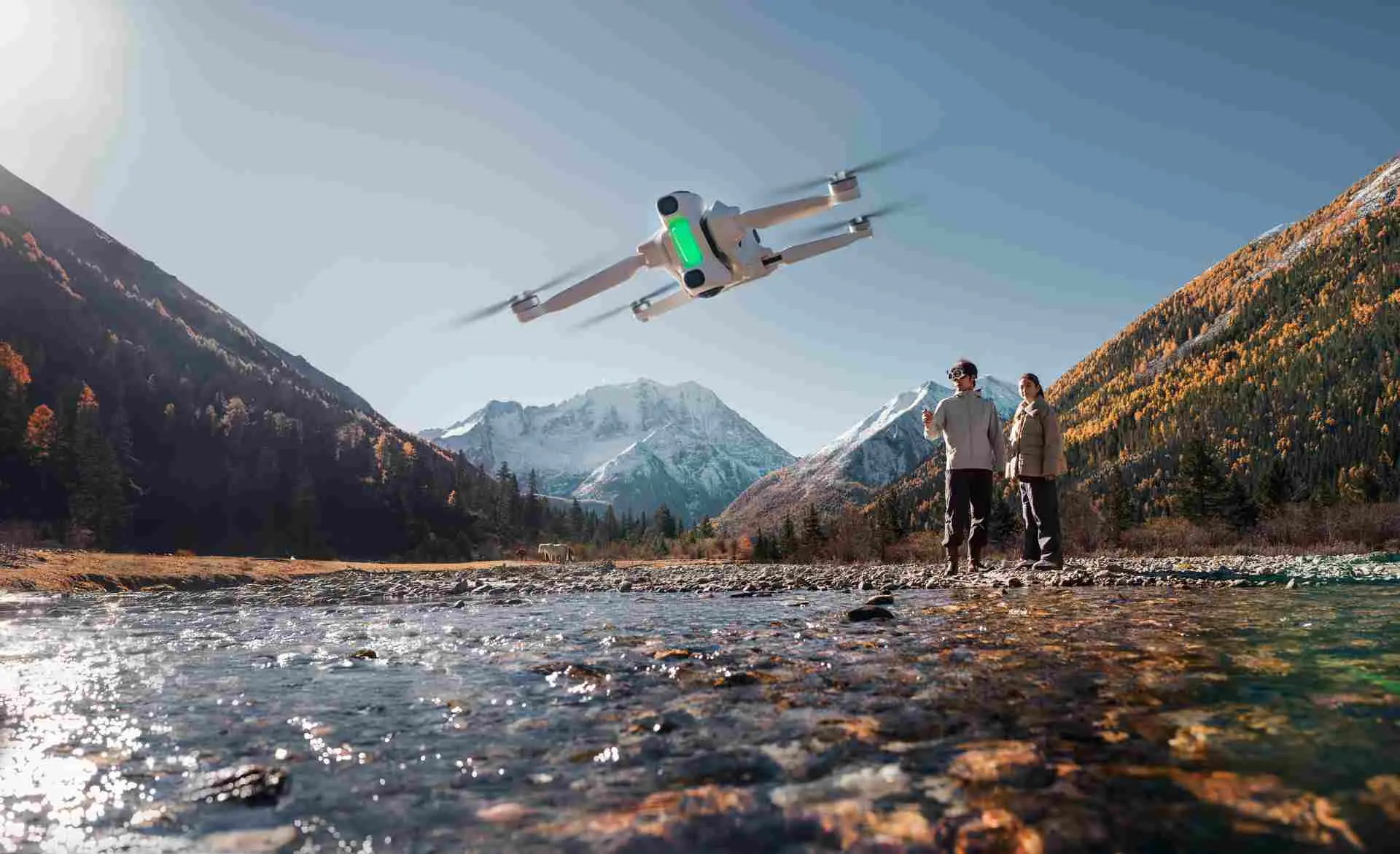
One of the most striking visual features is the motorized landing gear. Because a 360-degree camera sees "down" as well as "up" and "forward," traditional fixed legs would ruin the shot. Upon takeoff, the A1’s legs fold upward and inward, tucking themselves out of the field of view of the lower lens. This gives the drone a unique, almost insect-like silhouette in the air.

The dual-lens optical system
At the heart of the A1 are two 1/1.28-inch sensors paired with fisheye lenses. These are mounted on a dampened internal frame to mitigate the high-frequency vibrations produced by the motors. While the total video resolution is stated as 8K at 30fps, it is important to understand what that means in a 360-degree context.

When you capture a traditional 4K video, those pixels are concentrated into a single rectangular frame. In the A1, the 8K resolution is stretched across a full sphere. When you eventually "reframe" your footage into a standard 16:9 video, you are essentially cropping into a portion of that sphere. This means your final output is closer to a very high-quality Full HD rather than a native 4K.
| Feature | Specification |
| Video resolution | 8K at 30fps / 5.6K at 60fps |
| Stills resolution | 7680 x 3840 (Standard) / 10496 x 5248 (High Res) |
| Weight | 249g |
| Displays | Dual 2560 x 2560 Micro-OLED |
| Radio range | ~300m in urban environments |
The lenses are tuned for a wide dynamic range, and the "near-invisible" stitching is handled by software expertise inherited from industry leaders. In most lighting conditions, the seam where the two images meet is virtually impossible to spot, provided the subject is not positioned directly on the stitch line within a few feet of the drone.

A masterclass in immersive control
The A1 experience is split between the Grip controller and the Vision goggles. This is where the drone moves from being a camera to being an extension of your own senses.
The Vision goggles utilize a motion-tracking system that allows the pilot to look around the environment simply by moving their head. Because the camera is already recording in all directions, the drone doesn't need to physically rotate for you to see what is behind you. This creates a level of situational awareness that is unparalleled in the FPV world. If you want to check your surroundings or look at the horizon while the drone is flying forward, you simply turn your head.

The Grip controller is equally innovative. It moves away from the traditional "two-stick" radio transmitter design in favor of a more ergonomic, one-handed approach. It features a textured surface and an array of wheels and buttons that are surprisingly intuitive. The on-screen display in the goggles provides helpful "tool tips" that explain what each button does, which significantly flattens the learning curve for beginners.

One minor ergonomic quirk is the power system for the goggles. Instead of an internal battery that would make the headset heavy, the A1 uses an external battery pack worn as a necklace. It connects via a USB-C to barrel cable. While this keeps the goggles lightweight and comfortable for long sessions, the cable can occasionally feel a bit cumbersome during high-activity flights.

Flight performance and situational awareness
In the air, the A1 is snappy and responsive. It doesn't have the raw, screaming speed of a dedicated 6S racing drone, but that is expected given the weight and the focus on stabilized cinematography. The inclusion of dual optical collision sensors at the front provides a safety net that is often missing from FPV-style aircraft.
The radio range is perhaps the only area where the drone shows its limits. In urban testing with significant interference, the signal begins to reach its threshold at around 1800 meters. While this is plenty for most creative shots and close-proximity flying, users looking to do long-range mountain exploration may find themselves wanting more robust transmission power.
The flight time is excellent (over 28 minutes with each battery), though the battery is proprietary and cannot be swapped with the goggles' battery. This is a missed opportunity for cross-compatibility, but given the specific voltage requirements of the drone's flight controller versus the goggle's Micro-OLED displays, it is a logical engineering trade-off.
The power of post-flight reframing
The true magic of the A1 happens after the drone has landed. Because the device records everything, the concept of "missing the shot" effectively disappears.
When you pull the footage into the desktop or mobile app, you can choose exactly where the camera is looking at any given second. You can track a moving subject, perform dramatic 360-degree rolls, or switch from a wide-angle landscape to a vertical crop for social media—all from the same flight data.
The software allows for keyframing, which means you can direct the camera's path with precision. The AI tracking is excellent for subjects like people or vehicles that stay within a reasonable distance of the drone. However, the AI can struggle when objects pass behind obstacles or when the subject is too distant, requiring manual keyframe adjustments to maintain a perfect lock.
Market positioning and value
At $1,599, the A1 is not a budget drone. It is an investment in a new way of storytelling. When compared to the DJI Avata 2, the A1 is more expensive, but it offers a capability that the Avata simply cannot match: the ability to decouple flight direction from camera direction.
In a traditional FPV setup, the camera is fixed. If you want to look left, the drone must fly left. With the A1, you can fly straight ahead while the "camera" looks at a sunset to the side, or even directly behind you. This mimics the results previously only possible with a two-person crew (a pilot and a gimbal operator) using rigs like the DJI Inspire 3, which costs significantly more.
Final thoughts on a revolutionary platform
The Antigravity A1 is more than just a "world's first" gimmick. It is a polished, professional tool that successfully merges the worlds of 360-degree imaging and aerial robotics. It is an insectile, 249g powerhouse that prioritizes creative freedom over raw megapixels.

While the resolution may leave still photographers wanting a bit more detail, and the urban range could be improved in future iterations, the core experience is a triumph. It is intuitive enough for a novice to pick up but deep enough for a professional to create content that was previously impossible.
This is the start of a new chapter in drone design—one where the pilot is no longer limited by where the "nose" of the drone is pointing.
Popular News
Latest News
Loading