
The Xiaomi 17 series is the first mobile phone lineup to debut Qualcomm’s latest Snapdragon 8 Elite Gen 5 chip. But
being first doesn’t always mean being the fastest.
Early benchmark results
suggest that Xiaomi’s new flagship devices are lagging. This means that it may not be fully utilizing the chipset’s potential. The result reveals that the device shows only minor gains over last year’s top performers.
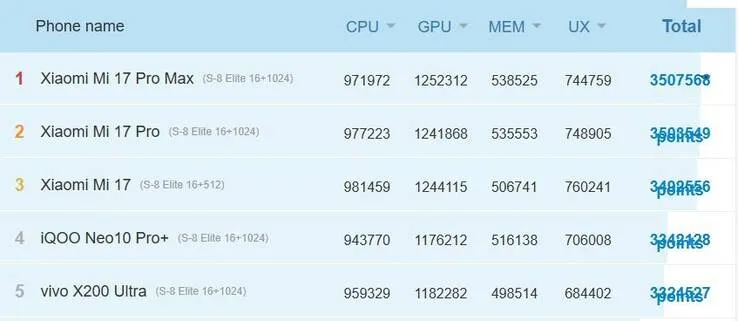
Source: AnTuTu
Small Jump in AnTuTu Scores
According
to AnTuTu’s latest performance charts, the Xiaomi 17 posts a CPU score of
981,459. On paper, that’s impressive, but only about 3% higher than the Vivo
X200 Ultra.
Recall that the Vivo X200 Ultra runs on last year’s Snapdragon 8 Elite and manages 959,329.
Strikingly, the Xiaomi 17 Pro and 17 Pro Max trail even behind the standard
model. The results paint a picture of modest progress rather than a major leap
forward.
With this setback, what might be delaying the chip may be tuning or software optimization.
It’s not the first time this has happened. Xiaomi mobile phones often score below expectations compared to rivals using the same hardware.
Geekbench Results Tell the Same Story
The
picture remains consistent on Geekbench. Pre-release leaks suggest the
Xiaomi 17 series could hit scores of around 3,700 in single-core. In multi-core tests, the claims were as high as 11,000. However, the real-world numbers have been less generous.
Review units from well-known testers
back this up. Ben’s Gadget Reviews reported scores of 3,376 and 10,120, respectively. Sahil
Karoul’s unit scored 3,328 and 10,210. Similarly, Mrwhosetheboss measured 3,407 and
10,416. Those results are solid but fall short of what many expected from
Qualcomm’s newest chip.

For comparison, the Oppo Find X8
Ultra with last year’s Snapdragon 8 Elite managed 3,145 and 9,722. This is close
enough to make the generational jump look modest.
Qualcomm’s own reference
device for the 8 Elite Gen 5, however, reached 3,832 and 12,459. This shows just
how much performance Xiaomi may be leaving on the table.
Conservative Tuning Likely to Blame
The
slow result may come down to the approach of Xiaomi. The company is
known for tuning down power. Xiaomi always wants to control temperature and battery life. If these are tuned down, then the overall performance will also be low.
Samsung does much the same, with its own chip running a bit low, too. But in Samsung's case, it is only slightly lower. In many cases, it goes unnoticed.
Popular News
Latest News
Loading