Dimensity 9000 vs. Snapdragon 8 Gen 1 Special Review: Performance/Energy Efficiency & more
PhonesFriday, 15 April 2022 at 17:12
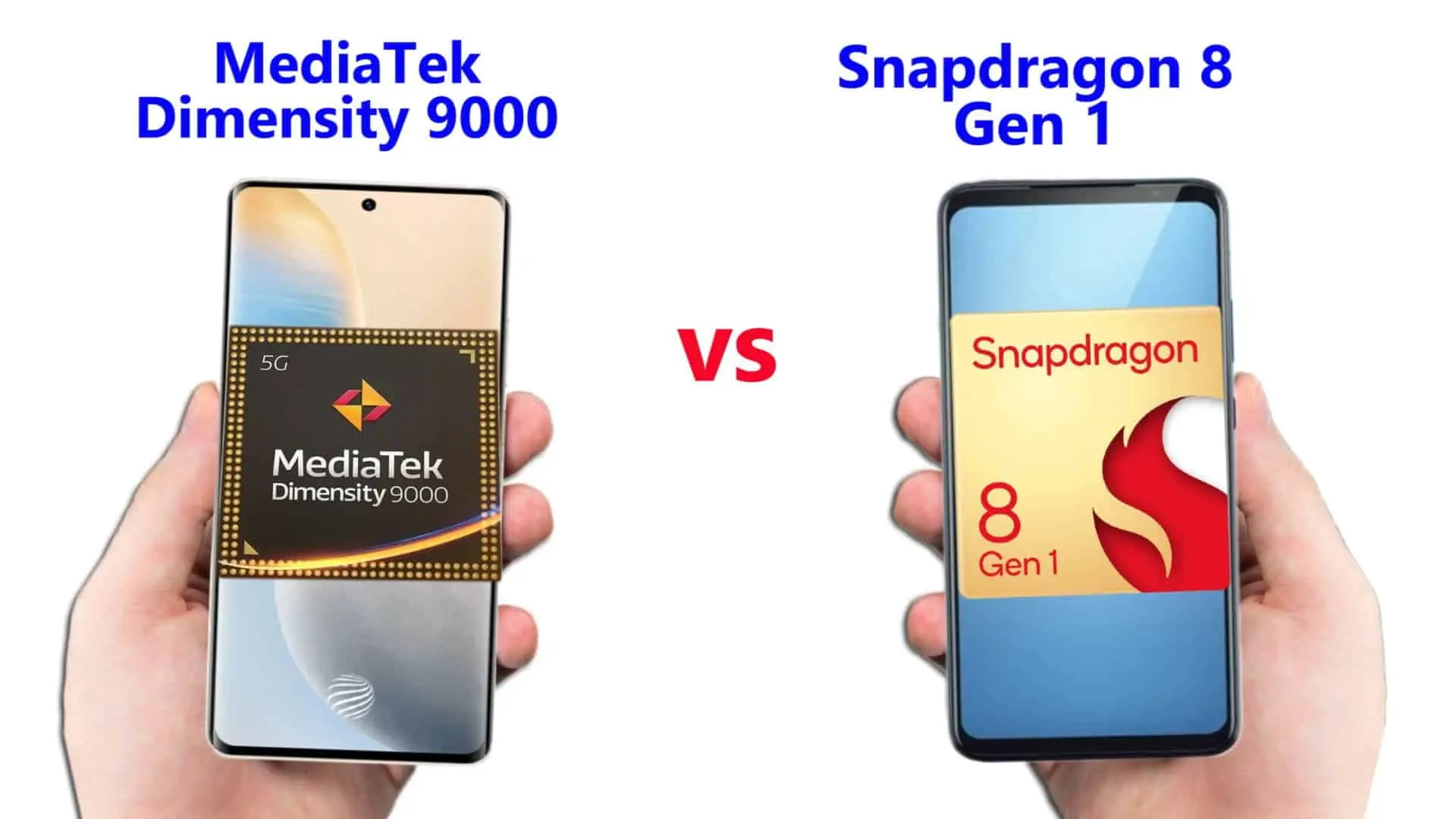
The arrival of the Dimensity series ushered in a new dawn for MediaTek chips. In less than two years, the company is now making meaningful impacts in the flagship market. Today, it has a lot of advantages and the Dimensity 9000 has been attracting a lot of attention. Today, what we are going to do is a more in-depth comparison test. We will conduct a full-scale head-to-head comparison between the Dimensity 9000 and the Snapdragon 8 Gen 1. For the technical specification and previous comparison of these chips, click here.
Dimensity 9000 vs. Snapdragon 8 Gen 1
Theoretical performance: CPU performance is absolutely extreme
First of all, let's review the similarities and differences between the Dimensity 9000 and the Snapdragon 8 Gen 1 processor using theoretical benchmarks.
The first is the CPU. Both the Dimensity 9000 and the Snapdragon 8 Gen 1 uses the same architecture design. One X2 super core plus three A710 large cores and four A510 small cores. The two chips are only slightly different in frequency and cache, and the Dimensity is higher.

Geekbench 5 & GFXbench
In Geekbench 5, the single-core score of the Dimensity 9000 is 10% higher than that of the Snapdragon 8 Gen 1. The multi-core score is even more amazing, Dimensity 9000 leads by about 21.3%. In fact, it even reaches the same level as the A14 Bionic.

In the GPU part, the Dimensity 9000 still uses the public version of the Mali GPU, but the latest Mali-G710 ten-core GPU. The Snapdragon 8 Gen 1 comes with the Andreno 730.

As shown in the GFXbench running score, the extreme performance of the Dimensity 9000 GPU is slightly inferior to that of the Snapdragon 8 Gen 1.
This generation of Snapdragon 8 Gen 1 has a huge GPU improvement. However, the actual game benefits are not so obvious. Therefore, in addition to theoretical performance, auxiliary testing of actual games is also required.
AnTuTu
On AnTuTu, the Dimensity 9000 flagship running score is 1,007,470 points, while the Snapdragon 8 Gen 1 under the same conditions has only 977,951 points. The performance release of the Dimensity 9000 in normal use at room temperature is also better than that of the Snapdragon 8.

In addition, the biggest difference between the two chips is in the manufacturing process. The Dimensity 9000 uses the latest TSMC 4nm process. However, the Snapdragon 8 Gen 1 chooses Samsung's 4nm foundry. Although the same 4nm process is used, the gap between the two is not small. The actual difference will be seen later in the heat generation and energy consumption section.
Gaming Tests
Genshin Impact
In the game test, our first choice is the recently popular mobile game "Genshin Impact".

Whether it is the Snapdragon 8 Gen 1 or Dimensity 9000 model, it supports 720P resolution. This is convenient for us to compare under the same frame rate conditions. "Genshin Impact" opens the highest picture quality at +60 frames.

The scheduling of Dimensity 9000 and Snapdragon 8 Gen 1 is completely different. The former is basically stable between 60 frames and 55 frames, while the latter is stable for a period of 60 frames, down-frequency for a period of time, and then returns to 60 frames to run. However, in terms of the final average frame rate, the two are similar. The average frame rate of the Dimensity 9000 is 57.94 FPS, and the Snapdragon 8 is 57.28 FPS.

Honor of Kings
For another popular game "Honor of Kings", both mobile phones also supports high frame rate mode. The test uses the highest picture quality, +120 frames.

The test results of "Honor of Kings" are also very similar, with the Dimensity 9000 averaging 119.31 FPS and the Snapdragon 8 Gen 1 average is 119.29 FPS.

Although the theoretical GPU running points of the Dimensity 9000 and the Snapdragon 8 Gen 1 are quite different, from the actual game test, the gaming performance is not much different.

For existing games, the performance of the two processors is very similar. When encountering complex scenes or overheating, it is necessary to drop frames. For "Genshin Impact", which is currently the most powerful game, both chips control the highest picture quality level of 720P.
Temperature control
The frame rate performance during gaming is almost the same, so does the temperature also make a difference? The temperature tests are carried out simultaneously under the same conditions of room temperature and pressure.
Genshin Impact
After nearly 8 minutes of testing, the maximum temperature of the core area of the back cover of the Snapdragon 8 Gen 1 hit 44.3°C. However, the core area of the back cover of the Dimensity 9000 is only 41.6°C. Here, the temperature difference is very obvious. This difference will most likely increase with longer gaming periods.
Honor of Kings
Using "Honor of Kings", the temperature control of the Dimensity 9000 is still better than that of the Snapdragon 8 Gen 1. The former is only 39.5°C, while the latter's temperature reaches 42.1°C.
We can see that in daily games Dimensity 9000 does a better job than the Snapdragon 8 Gen 1. On average, we can say that the Dimensity 9000 is 3°C cooler than the Snapdragon 8 Gen 1.
Power consumption and energy efficiency ratio
The lower heat generation is an indication that the power consumption of the Dimensity 9000 is also lower. So let us take a look at the actual power consumption tests of these flagship processors.
CPU
The first is the power consumption of the CPU. In the Geekbench 5 test, there are two parts of the single-core multi-core test, which can roughly estimate the single-core power consumption and multi-core power consumption of the two chips. According to the running score, we can further obtain the energy consumption ratio of the two chips.

Regardless of single-core or multi-core, the Dimensity 9000 not only has a higher score but also has a much better power consumption performance than the Snapdragon 8 Gen 1. It can be seen that TSMC's 4nm process does have certain advantages, and the overall energy efficiency ratio is between 10% and 20%.
GPU
For the energy efficiency ratio test of the GPU part, we specially selected GFXbench's 1080P racing chase off-screen test and 1080P Manhattan 3.1 off-screen test as separate test items.

The results of the separate test are similar to expectations. The running score of the Snapdragon 8 Gen 1 is higher than that of the Dimensity 9000.
When substituting the power consumption and energy efficiency ratio in the test, although the running score of the Dimensity 9000 is slightly inferior, the overall energy efficiency ratio can be much higher.
Actual game test
Actually, to test the comprehensive power consumption performance in the game, we continue to use "Genshin Impact" as the test object.
In the highest quality +60 frame mode, both the Dimensity 9000 and the Snapdragon 8 Gen 1 can achieve almost full-frame game performance (57.94/57.28). However, the power consumption of the two is very different.

The average power consumption of the Dimensity 9000 throughout the game is only 4.98W. However, the power consumption of the Snapdragon 8 Gen 1 reaches 6.4W.
According to the energy consumption ratio converted from frame rate and power consumption, the frame rate per watt of Dimensity 9000 is 11.63, while that of Snapdragon 8 is 8.95. This means that the Dimesnity 9000 is about 30% better overall.

TSMC's 4nm process is not useless. With MediaTek's global power consumption optimization technology, the Dimensity 9000 is indeed better in terms of power and energy efficiency ratios. It can save power and control temperature better.
Conclusion
In terms of performance and energy efficiency, MediaTek Dimensity 9000 is a clear winner. In many performance tests, Dimensity 9000 did not lose to the Snapdragon 8 Gen 1. Through the benchmark test, we will find that the CPU performance of the Dimensity 9000 is even stronger.
In terms of energy efficiency ratio, the Dimensity 9000 does not lose the reputation of TSMC's 4nm, and with the support of MediaTek's global energy efficiency optimization technology, Dimesity 9000 is about 3°C cooler. In the power consumption test, it also has a higher energy efficiency ratio. It also comes with better heat control.
Both chips are actually very similar theoretically. However, practically, Dimensity 9000 leads in almost all ramifications. Even on the GPU end that Snapdragon 8 Gen 1 leads on paper, the actual performance is not far from the Dimensity 9000.
Popular News
Latest News
Loading