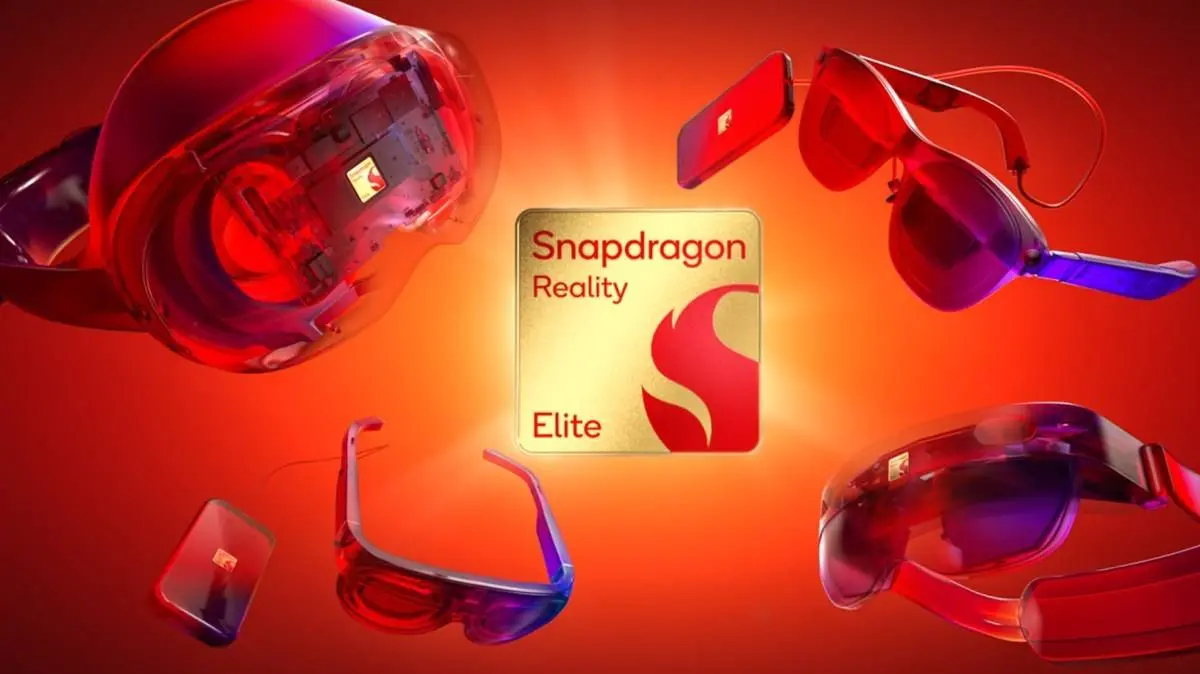
Qualcomm just announced the Snapdragon Reality Elite at AWE 2026 — the Augmented World Expo — and it's the company's most significant XR platform in years. Designed to power everything from standalone mixed-reality headsets to lightweight tethered smart glasses, it's a major leap over the XR2+ Gen 2 that's been carrying the load in devices like the Samsung Galaxy XR. The numbers are hard to ignore: 60% more GPU performance, 160% more NPU performance, and 20% longer battery life at the same workload.

Summary
- Snapdragon Reality Elite delivers 30% higher CPU, 60% higher GPU, and 160% higher NPU performance versus the Snapdragon XR2+ Gen 2.
- The Hexagon NPU hits 48 TOPS — enough to run LLMs and large vision models on-device, with 10 more tokens per second than Apple Vision Pro.
- Display support tops out at 4.4K per eye at 90fps, with hardware-accelerated ray tracing and mesh shading onboard.
- Battery life improves by up to 20% at the same workload; the chip runs up to 12°C cooler under load.
- XREAL Project Aura and Play for Dream's next-gen headset are first in line; Qualcomm keeps the AR1+ chipset for simpler AI glasses.

What "Reality Elite" Actually Means in Practice
The naming change matters more than it might seem. Qualcomm is moving away from the XR2 numbering to position this as a distinct platform — a purpose-built XR chip rather than a mobile SoC repurposed for headsets. The Kryo CPU runs a 4+2 performance core configuration. The Adreno GPU gets hardware-accelerated ray tracing and mesh shading. DDR bandwidth jumps 30% over the previous generation. And the EVA block — a dedicated Engine for Visual Analytics — handles computer vision workloads in hardware rather than dumping them on the main cores.
That EVA block is actually where a lot of the magic lives. VST passthrough latency drops, image quality improves, and digital objects blend more cleanly with the physical environment. It's the kind of under-the-hood work that doesn't make a spec sheet pop but determines whether mixed reality feels real or just adjacent to real.

The AI Story: 48 TOPS and What You Can Do With Them
Here's the part that Qualcomm is most excited about, and frankly it's justified. At 48 TOPS, the Hexagon NPU inside the Reality Elite can run photorealistic avatars using Gaussian Splatting, LLM-based agents, and real-time 3D object generation via large vision models — all on-device, no cloud dependency. Qualcomm also claims the chip delivers 10 more tokens per second than Apple Vision Pro, which is a bold comparison to make publicly and suggests confidence in the benchmarks.
"Qualcomm claims the Snapdragon Reality Elite delivers 10 more tokens per second than Apple Vision Pro — a direct shot at the only premium headset that's actually shipping at scale."
The distinction between VST (video see-through, like Meta Quest) and OST (optical see-through, like smart glasses) devices is worth understanding here. The Reality Elite handles both, which is unusual. Most XR chips optimize for one or the other. Qualcomm's pitch is that this single platform covers the full spectrum — standalone headsets, tethered MR glasses, and lightweight optical designs like XREAL Project Aura. For simpler AI glasses in the Meta Ray-Ban class, the AR1+ chipset stays in play.
Read also

Who's Building With It First
XREAL Project Aura is first up, launching later this year as a tethered Android XR device. Play for Dream follows with an undisclosed next-gen immersive headset. More partners are expected — the XR market now sits at over 60 million devices globally, and Qualcomm powers the vast majority of Android XR hardware.
I suppose the real test isn't the spec sheet. It's whether the devices running this chip finally make spatial computing feel inevitable rather than impressive-but-niche.
Popular News
Latest News
Loading