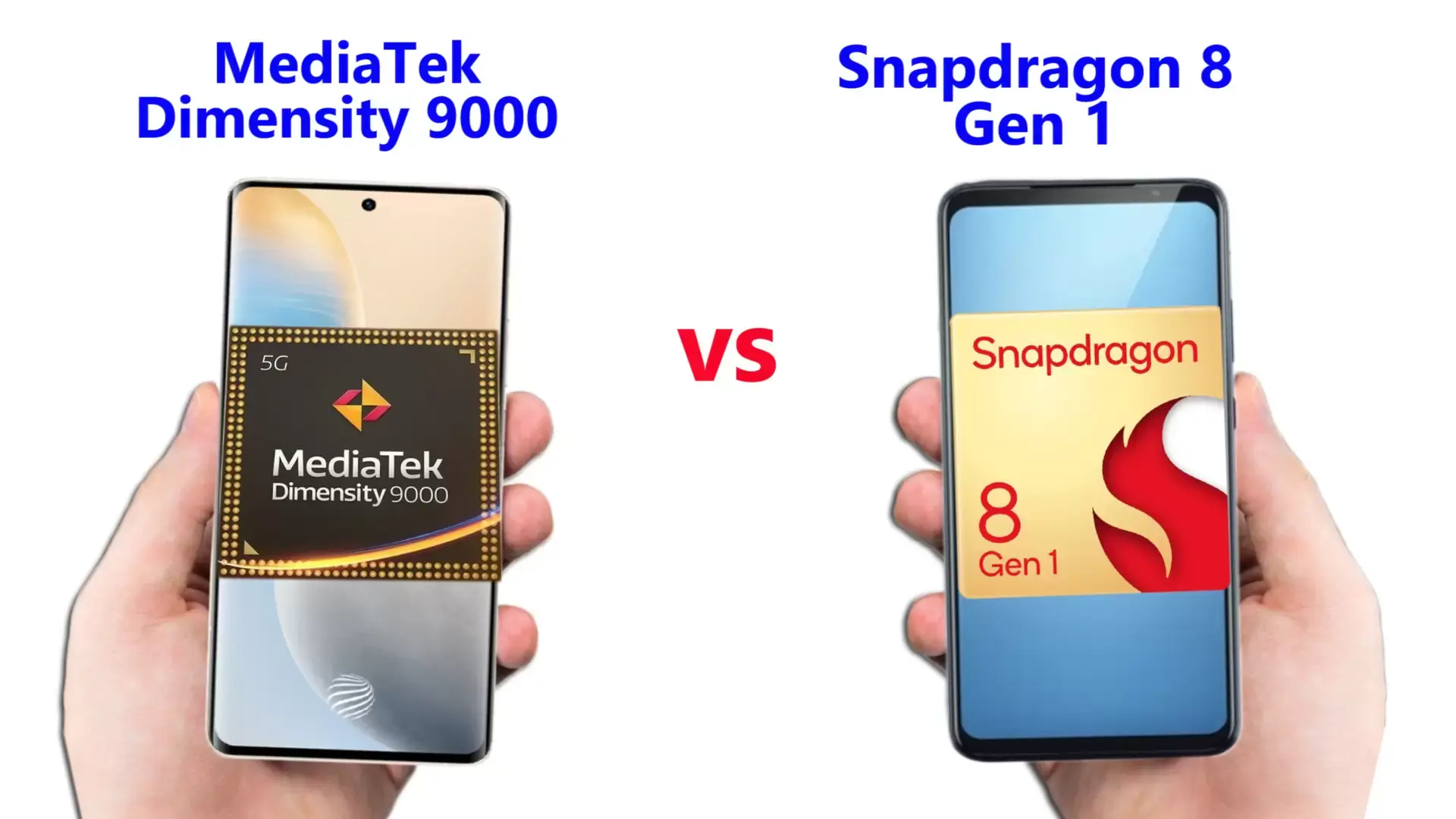
Since the official release of the Dimensity 9000 and Snapdragon 8 Gen1, there has been a consistent tussle on which of these chips is better. No doubt, in the flagship field, Qualcomm has always been ahead of MediaTek. However, it appears that the MediaTek Dimensity 9000 will bridge this gap. Both the Dimensity 9000 and Snapdragon 8 Gen1 are basically the same. However, while the former uses TSMC 4nm manufacturing process, the latter uses Samsung's 4nm process.

Now, some of the industry's renowned performance testing databases have released test scores for these processors. Let us take a look at the performance of both chips from the results available so far
AnTuTu
On AnTutu 9.0.7 MediaTek Dimensity 9000 runs scores 1,017,488. The CPU score is 256,987, the GPU score is 393,810, the MEM score is 186,890, and the UX score is 179,801. As for the Qualcomm Snapdragon 8 Gen1, it scores 1,031,508 on AnTuTu 9.2.1. The CPU score is 233,625, the GPU score is 451,861, the MEM score is 174,104, and the UX score is 171,918

GeekBench 5
Next, let’s look at the GeekBench 5 running score. The Dimensity 9000 scores 1273 in GeekBench 5.1 for single-core and 4324 for multi-core. As for the Snapdragon 8 Gen1, on GeekBench 5.1, it scores 1234 for the single-core and 3837 for the multi-core tests.

PC Mark
In the PC Mark score, Dimensity 9000 scored 17,573 in the Work 3.0 test while the Snapdragon 8 Gen 1 scored 17,084.
GFX-Manhattan
When it comes to graphics testing, Dimensity 9000's GFX-Manhattan 3.0 test Offscreen (1080p) is 238 Fps while the Snapdragon 8 Gen 1 is 267 Fps. The Manhattan 3.1 Offscreen (1080p) of Dimensity 9000 is 162Fps, and the Snapdragon 8 Gen 1 is 176Fps.
Aztec Ruins
On Aztec Ruins Vulkan (High Tier) Offscreen (1440p), the Dimensity 9000 SoC scores 43Fps. However, the Qualcomm Snapdragon 8 Gen1 scores 49Fps. On Aztec Ruins OpenGL (High Tier) Offscreen (1440p), Dimensity 9000 scores 42Fps while Snapdragon 8 Gen 1 at 43Fps.

AI Benchmark
AI BenchMark shows that Dimensity 9000 has a final score of 692 points, completely killing all Android chips. Qualcomm Snapdragon 8 Gen1 is also far behind Dimensity 9000 with a score of 560. The Kirin 9000 and Snapdragon 888 are also far behind the Dimensity 9000 in terms of AI performance.

It should be noted that it may be difficult to feel the gap in AI performance in consumers' daily use. At present, AI is mainly used in scenes such as face recognition, photographing, AR 3D animation special effects, voice recognition, and mobile phone smart assistants. Higher AI performance can make facial recognition faster and more accurate, make voice assistants more intelligent, and allow the system to learn user habits, pre-load apps at different time periods, and open faster, etc. To put it simply, AI performance represents the "smartness" of a chip and a mobile phone. Products with stronger performance can bring a smarter experience, making a smartphone more than just a screen device that can install apps.
From the benchmark results so far, it appears that both chips have their highs and lows. While the CPU scores seem to favour Dimensity 9000, the GPU appears to favour Snapdragon 8 Gen1. However, AI is clearly for the Dimensity 9000 but AI is not usually s a defining boundary for smartphone chips. It appears that the overall performance of these chips will narrow down to how well they can handle the temperature.
Technical Specifications - Dimensity 9000 Vs Snapdragon 8 Gen1
Dimensity 9000 flagship processor
The Dimensity 9000 chip uses TSMC's 4nm process + Armv9 architecture combination and has a high-performing Cortex-X2 super-large core. In addition, it has 3 Arm Cortex-A710 large cores (frequency 2.85GHz) and 4 Arm Cortex-A510 energy efficiency cores. This chip also supports LPDDR5X memory and the speed can reach 7500Mbps.

Dimensity 9000 adopts a flagship 18-bit HDR-ISP image signal processor. This technology can shoot HDR video with three cameras at the same time. Furthermore, the chip has a low power consumption performance. This chip comes with a high-performance ISP processing speed of up to 9 billion pixels/sec. It also supports triple exposure for triple cameras as well as up to 320MP cameras. In terms of Al, Dimensity 9000 uses MediaTek’s fifth-generation Al processor APU. This is 4 times more energy-efficient than the previous generation. It can provide a high-efficiency AI experience for shooting, gaming, video, and other applications. In terms of games, Dimensity 9000 uses Arm Mali-G710 graphics processor and launched a mobile ray tracing SDK kit. This includes Arm Mali-G710 ten-core GPU, mobile ray-tracing graphics rendering technology, support 180Hz FHD+ display.
Snapdragon 8 Gen1 technical specs
The CPU keeps the three-cluster design and is perfectly in line with the previous leaks. There is a Prime Core with an ARM Cortex-X2 core with a 3.0 GHz clock speed. There are also three "supporting" performance cores based on the newer ARM Cortex-A710 standard. Those will run at 2.5 GHz. Finally, we have four efficiency cores that will also sport the new ARM Cortex-A510 standard running at 1.8 GHz.


Overall, the new CPU will be 20 percent faster than the one in the Qualcomm Snapdragon 888. It will also reduce power usage by up to 30 percent. That certainly is a significant upgrade. The upcoming Xiaomi 12, for example, will be 20 percent faster than its predecessor.
Now the next big thing is on the GPU part. The new chipset introduced the new Adreno 730 GPU with a 30 percent performance boost and up to 25 power-saving thanks to its new architecture. Qualcomm developed three Elite Gaming features, one of which will allow developers to strike a balance between performance and power efficiency. The Adreno Frame Motion Engine allows the GPU to render a game at double the frame rate while using the same amount of power. Alternatively, it can keep the FPS the same while cutting power draw by half.

The set of new features also include desktop-class volumetric rendering. It is used for dramatic lighting effects, the god rays that level designers seem to love so much. Also new is Variable Rate Shading Pro, an image-based VRS that should streamline the integration of VRS into more games. According to the chipmaker, there are already many partnerships with solid game developers to extract the best of the new hardware.
Connectivity, Media, and Security
The Snapdragon 8 Gen 1 brings an integrated X65 5G modem. It offers support for both sub-6 and mmWave operations. It can deliver theoretical peak speeds of 10 Gbps. For the first time, it also supports carrier aggregation for the uplink.
Local connectivity enjoys Wi-Fi 6 and 6E support, plus improvements to Bluetooth. The new chip is capable of streaming CD Lossless Audio over Bluetooth LE. It also supports Bluetooth LE Audio. It also offers support for Stereo recording along with voice-back channels.

Qualcomm also ensures top-notch security with its new flagship SoC. There is a new Trust Management Engine. It will sit below the hypervisor standard. The new Engine will remain secure even if the security zones above it are compromised.
Popular News

Latest News
Loading