Samsung Galaxy Z Fold 8 Wide rumors suggest an almost crease-free experience
SamsungMonday, 15 June 2026 at 08:18
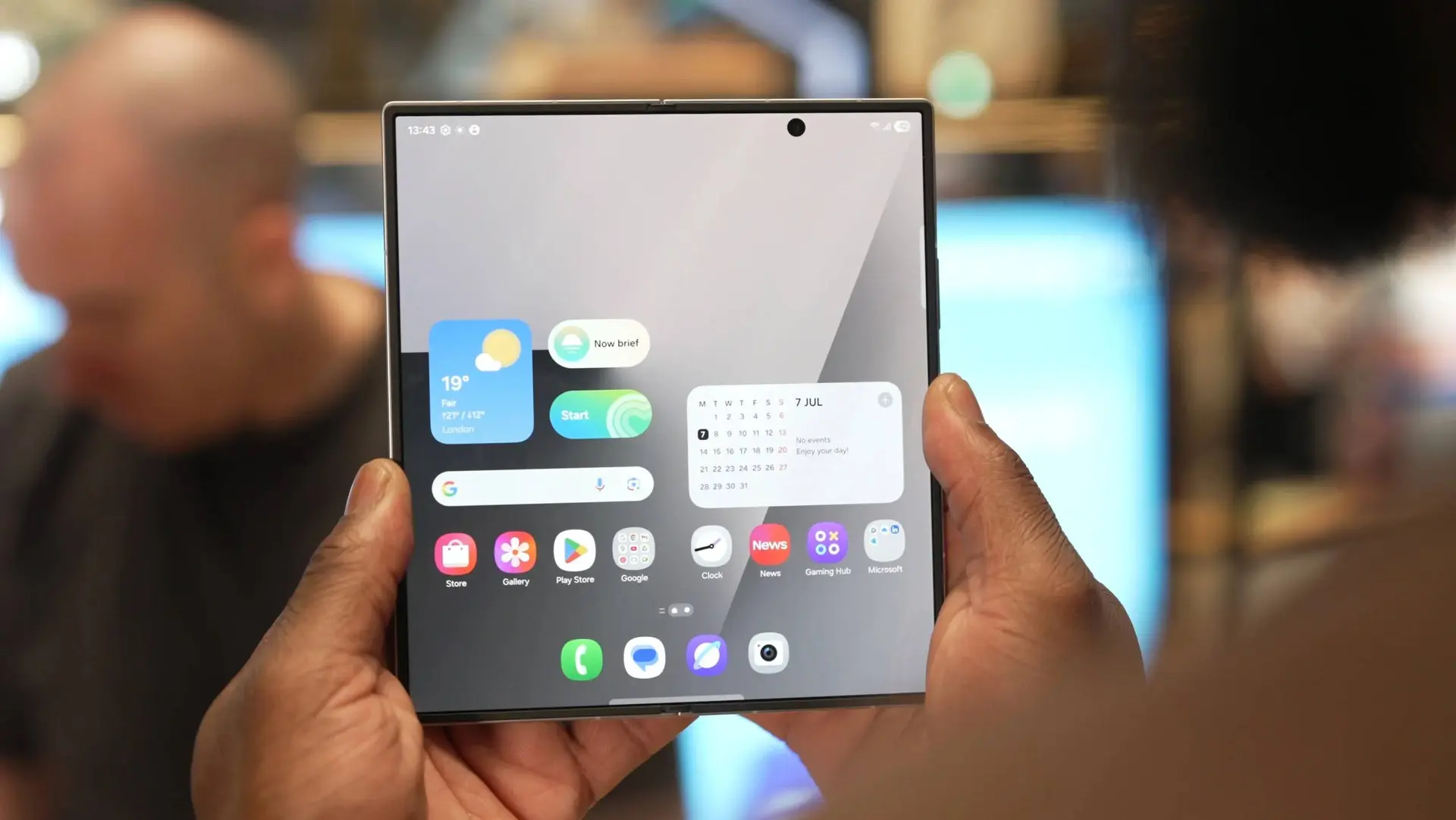
The 60-micron headline is the what. CES 2026 already showed us the why.

Summary
- Supply chain reports confirm Samsung is testing 60-micron Ultra Thin Glass on the Galaxy Z Fold 8 Wide — up from the 45-micron UTG used on the Z Fold 7 and Z Fold 8 Ultra, following from the Z Fold 6's 30-micron baseline — delivering a confirmed 20% reduction in crease depth compared to the current generation.
- The crease reduction isn't achieved by thicker glass alone: Samsung's Advanced Crease-less panel technology applies UTG on both the top and bottom of the display stack, adds laser-drilled micro-perforations to the backplate, and uses an optimized laminate structure to distribute folding stress across the whole display rather than concentrating it at the hinge.
- Samsung is treating the Z Fold 8 Wide as a controlled commercial experiment — shipping 60-micron UTG on the wider-aspect 4:3 model first, with the Z Fold 8 Ultra retaining the standard 45-micron glass, before committing the technology to the full Z Fold 9 lineup in 2027.
- If the Z Fold 8 Wide validates the 60-micron UTG in real-world use, the Z Fold 9 becomes the critical model — the first Samsung foldable to launch after Apple's iPhone Ultra enters the market, meaning crease quality becomes a head-to-head comparison point for the first time.
- Samsung's shipment target for the Z Fold 8 Wide is approximately 1.5–2 million units — modest but deliberately scoped to test real-world durability and consumer reception of the new display technology before wide adoption.
Samsung displayed its Advanced Crease-less technology at CES 2026 in January, and it caused a reaction — the booth drew crowds specifically to see how much less visible the crease was versus the Galaxy Z Fold 7. What's happening with the Z Fold 8 Wide is the commercial implementation of that demonstration, at a deliberately limited production volume to validate it before betting the Z Fold 9 on it.
Why the Dual-UTG Structure Matters More Than the Thickness Number
The thickness jump from 45 to 60 microns is real and meaningful on its own — thicker glass resists scratches better, holds its shape under finger pressure, and creates a subtler crease geometry. But the more significant innovation is the dual-layer application. Conventional UTG covers only the top surface of the foldable display. Samsung's new architecture places UTG at the bottom of the panel as well. Combined with laser-drilled micro-perforations in the metal backplate — tiny holes that allow the rigid backing to flex during folding without concentrating stress — the system addresses the crease problem from both directions simultaneously.
Read also


The analogy that helps: current foldable displays behave like a piece of paper folded over a rigid ruler. The dual-UTG design is more like paper folded over a surface that flexes with it. Stress distributes rather than concentrates. The crease exists, but it's shallower, and it recovers toward flat faster after the device is opened.
The Z Fold 8 Wide as Proof of Concept
Samsung's 1.5–2 million unit production target for the Z Fold 8 Wide is telling. This is not a volume product — it's a validation device. A million and a half units produces enough real-world durability data to assess whether 60-micron UTG holds up across the full range of consumer use cases: beach trips, airport handling, gym bags, accidental drops. If the crease improvement holds and the durability metrics are acceptable, the technology gets approved for the Z Fold 9 at full production scale.
The Z Fold 9 launch in 2027 is the genuinely high-stakes moment. Apple's iPhone Ultra foldable will be in market by then. First-generation iPhone foldable buyers will be making a comparison — and crease visibility is one of the most emotionally charged differentiators in the category. Samsung wants to arrive at that moment with a hardware answer, not a software workaround.
Popular News



Latest News
Loading