Let’s Be Honest, AI Still Isn’t Replacing Humans in Creative Work
EditorialWednesday, 28 January 2026 at 02:46
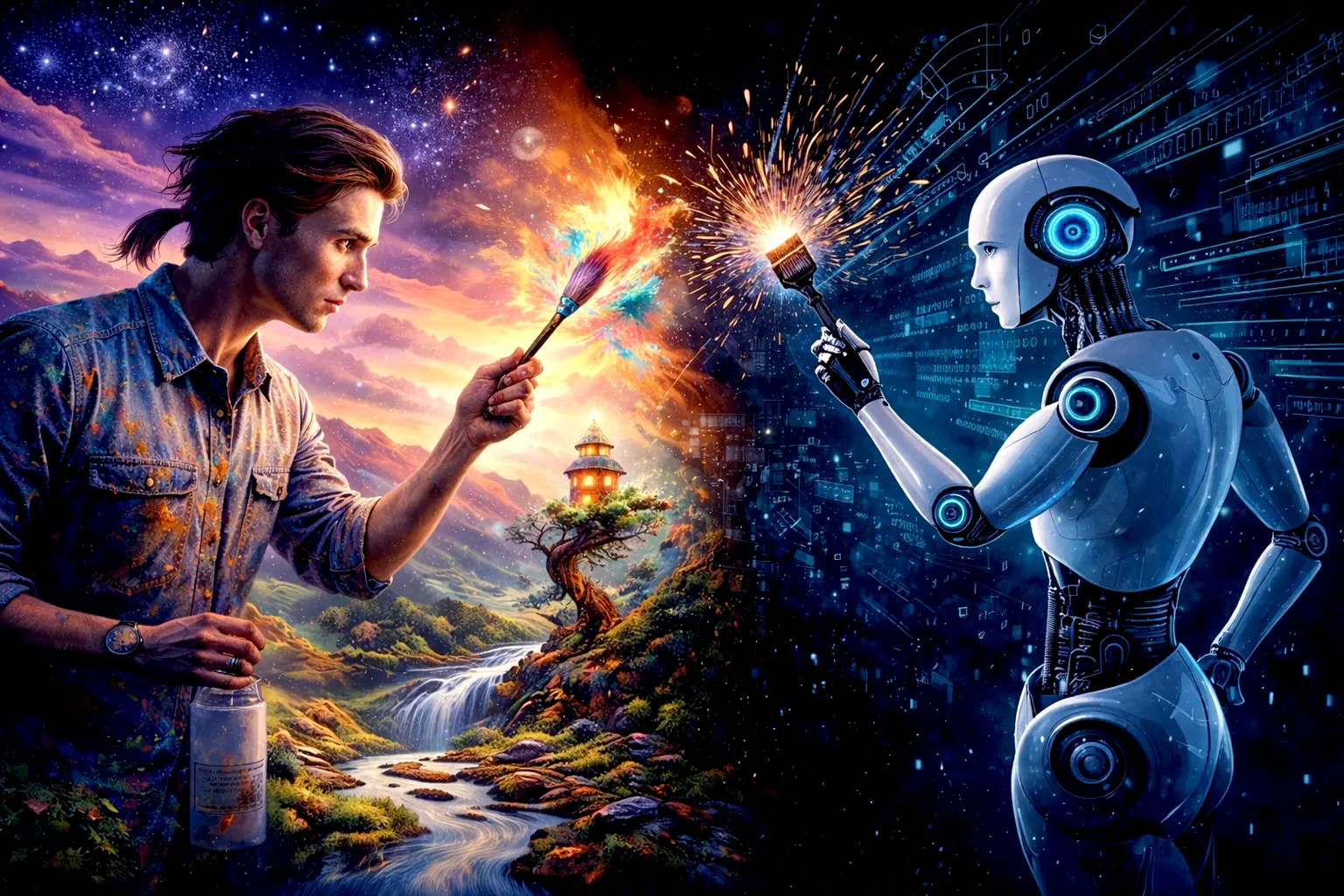
Every few decades, a new machine arrives that is supposedly here to escort humans out of the workplace, like we are guests who overstayed. Today’s version talks, paints, composes music, edits video, and writes essays at 2 a.m. without complaining about deadlines. Generative AI doesn’t really feel like a tool anymore, more like some creative machine that just keeps going. So people immediately assume humans are done.
Not quite.
Generative AI Changed Everything, But It Can’t Do It Alone
Generative AI is brilliant at producing content. It can create songs in styles that took musicians years to master, images that resemble professional photography, and scripts that look suspiciously like something a marketing team would proudly present. But there is a difference between producing material and actually doing the job.
The Creative work is not just output. It is an intention. A designer is not only arranging shapes and colors. She is solving a business problem, working within brand constraints, negotiating with stakeholders, and adjusting when the client says, “This is great, but also completely wrong.” AI can generate fifty logo ideas in seconds. It does not sit in a tense meeting while a company argues about what it wants to be.
Generative systems remix the past at scale. AI follows patterns, and humans don’t work like that. In fact, people make things because something bugs them, excites them, or won’t leave their head alone. Then, the creation process usually starts. The Art usually comes from lived experience, not probability. We all agree that AI has a bit of style, but the humans have stakes.
AI Can Flood Media and Websites With Generated "Soulless" Content
There is also the taste problem. AI can drown the world in content. However, that does not mean it knows exactly what is worth making. AI predicts, and Humans react. A person might create something because they’re annoyed, inspired, confused, or just can’t stop thinking about something. That’s where art usually comes from, real life, not pattern prediction. The value is not in unlimited generation, but in judgment. Without strong human direction, generative AI becomes a very enthusiastic intern who brings you one thousand ideas and expects you to sort the good ones from the digital noise.

AI Generated Images
Then comes trust. A news article, a documentary, a corporate report, or an educational video carries responsibility. Facts must be checked, and the legal risks must be considered. Ethical lines must be drawn. Generative AI can easily invent details that never existed. In creative hobbies, that is quirky. Try explaining to your boss that “the AI made it up” after publishing bad info in a news article or legal document. That excuse doesn’t save your name. Yours is the one on it.
Even in entertainment, where AI seems most threatening, audiences still connect with people. Fans follow artists not just for the sound. The sound may attract them, but after the buzz, they sympathize with their story, personality, and journey. A song written by an algorithm might sound good. A track born from a bad breakup or a rough phase has scars in it. That’s what people latch onto. Not just the sound, but the human behind it.
The Generative is an Improvement Tool, Not a Full Replacement
Things tend to heat up when it comes to the range of development and coding. There are a lot of talks around IA replacing actual developers. It's an undeniable fact: AI can write code. It handles boilerplate, suggests functions, and speeds up routine work. But coding is only a slice of what developers actually do.

Most dev work is problem-solving in different and messy conditions. The requirements are unclear, clients change their minds, and systems are full of legacy decisions nobody remembers. AI takes instructions, the developers question them, reshape them, and figure out what the real problem is. Code in demos is clean. Code in the real world is held together by history, deadlines, and decisions nobody fully remembers. AI can generate a neat solution, but humans make it survive reality.
AI will shrink the “type this function” part of the job. It will expand the thinking, architecture, communication, and decision-making parts. Devs who only write simple code are at risk. Devs who design systems and use AI as a tool become more powerful.
Highlights
- Generative AI can produce content fast, but producing material is not the same as doing a job.
- Jobs involve constraints, negotiation, responsibility, and unclear problems, not just output.
- AI predicts patterns from the past, while humans create from experience, emotion, and real-world stakes.
- Unlimited generation does not equal good judgment. Humans decide what is worth keeping and what should be discarded.
- In fields like journalism, law, and business, humans carry the legal and ethical responsibility. AI does not.
- Audiences connect with human stories and journeys, not just technically good content.
- In software development, AI writes code, but humans handle messy systems, legacy problems, and shifting requirements.
- AI reduces routine work but increases the value of thinking, architecture, communication, and decision-making.
- The future of work is not AI replacing humans, but humans using AI as a productivity tool.
- When everyone can generate, the real value shifts to judgment, taste, and standing behind the final result.
A Valid Companion For Those Who Know How To Use It
In practical workplaces, generative AI speeds things up. It drafts, sketches, suggests, and automates the blank page problem. That changes workflows, raises productivity, and shifts skill demands. But it also increases the need for humans who can direct the tools, spot mistakes, shape ideas, and make decisions that machines cannot justify beyond “the data suggested it.”

Honestly, before OpenAI's ChatGPT showed up, most of us couldn’t fully picture a world like this. Things are changing fast, and AI will likely get even more powerful as time goes on. But until then, it will need a lot of computing power and infinite resources that suppliers can't deliver.
Right now, the future doesn't sound to me like a world where AI replaces human creators and professionals. Perhaps, it is one where average output becomes easy and cheap, while human judgment, originality, and responsibility become more valuable. In a world where everyone can generate, the rare skill is not creation. It is judgment, taste, and the courage to put your name on the result.
Popular News

Latest News
Loading