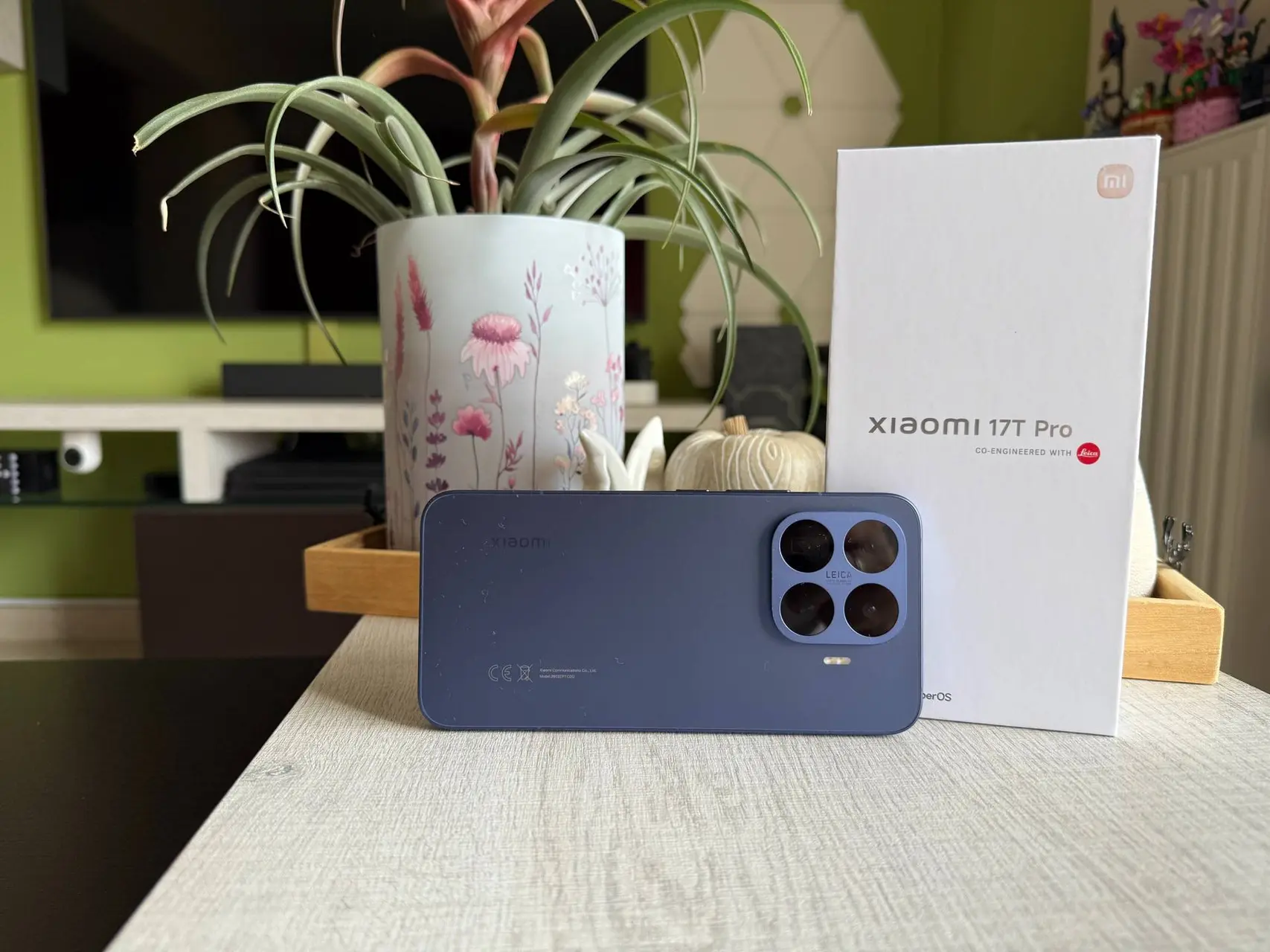
When you unpack a new phone these days, there is a certain rhythm you expect. You slide off the cardboard lid, lift out the glass rectangle, peel off some plastic, and wait for that familiar boot animation. But setting up the Xiaomi 17T Pro felt slightly different for me, mostly because I kept looking over at the white retail box sitting on my livi, right next to a potted plant that always seems to find its way into my test shots. It is an interesting device to hold, a solid chunk of hardware that feels substantial—maybe a little heavy at 219 grams, but reassuringly dense.

Summary
- Leica Camera System: The triple-lens array delivers distinct color profiles through a large 1/1.31-inch Light Fusion 950 sensor and a highly effective 5x periscope telephoto lens.
- Massive Battery Life: Packing a 7,000mAh silicon-carbon cell, the device easily clears two full days of typical usage without requiring a mid-day top-up.
- High-End Display: A spacious 6.83-inch AMOLED panel brings a 144Hz refresh rate and up to 3,500 nits of peak brightness for effortless outdoor visibility.
- Flagship Performance: Driven by the MediaTek Dimensity 9500 chipset, it handles intensive multitasking and heavy gaming with fluid responsiveness.
- Minor Compromises: While the primary and telephoto shooters shine, the ultrawide lens exhibits softer details in low-light environments.

The back of the phone, shows off a deep, dark blue finish that catches the room's lighting in a rather subtle way. The surface is matte, though it still collects a stray speck of dust or two if you leave it on a wooden table for ten minutes. Beside it stands the clean, minimalist white packaging, boldly carrying the Xiaomi 17T Pro branding right next to that recognizable Leica logo. It is an aesthetic that aims for premium territory, even if the square-ish camera module with its distinct lens cutouts might split opinion down the middle.

Xiaomi 17T Pro specifications
- 6.83-inch ( 2772 x 1280 pixels) 1.5K OLED display, 144Hz refresh rate, up to 3200Hz / 3500Hz instantaneous sampling rate, Dolby Vision, 3840Hz high-frequency PWM dimming + DC dimming, up to 3500 nits peak brightness, HDR10+, Dolby Vision, Corning Gorilla Glass 7i protection
- 17T – Up to 3.4GHz Octa-Core Dimensity 8500-Ultra 4nm SoC with Arm Mail-G720 MC8 GPU
- 17T Pro – Up to 4.21 GHz Octa-Core Dimensity 9500 3nm SoC with 12-core Mali G1-Ultra GPU and MediaTek NPU 990
- 12GB LPPDDR5X RAM with 256GB / 512GB / 1TB (UFS 4.1) storage
- Dual SIM (nano + nano)
- Xiaomi Hyper OS 3 based on Android 16
- 17T – 50MP main camera, 1/1.55″ Light Fusion 800 sensor, f/1.7 aperture, OIS, 12MP ultra-wide-angle, 50MP 5x periscope telephoto, f/3.0 aperture, OIS, Leica Summilux optical lens, up to 4K 60fps video recording
- 17T Pro – 50MP main camera (Light Fusion 950, 1/1.31″, f/1.67, OIS), 12MP ultra-wide-angle, f/2.2 aperture, 50MP 5x periscope telephoto, f/3.0 aperture, OIS, Leica Summilux optical lens, up to 8K 30fps video recording
- 32MP front-facing camera, 4K 30fps video recording
- In-display fingerprint sensor, Infrared sensor
- USB Type-C audio, Hi-Res audio, Dual speakers, Dolby Atmos
- Dust and water-resistant (IP68)
- Dimensions: 162.2x 77.5×8.25mm; Weight: 219g
- 5G SA/NSA, Dual 4G VoLTE, Wi-Fi 7 802.11 ax, Bluetooth 6.0, GPS: L1+L5Galileo: E1+E5a+E5b | GLONASS: G1 | Beidou | QZSS: L1+L5 | NavIC: L5, NFC, USB Type-C
- 7000mAh (Typical) battery with 100W HyperCharge, 50W wireless charging
The Everyday Experience with HyperOS and the Screen
Living with the phone means staring at its 6.83-inch AMOLED screen for hours on end, and I must admit, it is a very lovely panel to look at. Xiaomi claims it hits a peak brightness of 3,500 nits. Now, whether it actually reaches that exact number in daily use is hard to verify without lab gear, but standing outside in the bright, direct afternoon sun, I had absolutely no trouble reading text or framing a shot. The display handles reflections remarkably well. Everything looks sharp, colors are rich, and the 144Hz refresh rate makes scrolling through feeds feel incredibly fluid, even if most apps still cap things out at a standard 120Hz during regular navigation.
Software is where things get a bit more complicated for me. HyperOS 3.0 runs on top of Android 16 here, and it is fast—no doubt about that. The MediaTek Dimensity 9500 processor ensures that nothing stutters, apps open instantly, and multitasking feels completely effortless. Yet, the interface still feels a bit heavy-handed in places. There are too many pre-installed tools, and the notification shade behavior takes some getting used to if you are coming from a cleaner Pixel or a Samsung setup. It is not a dealbreaker by any means, but perhaps a reminder that Xiaomi still prefers to do things its own way when it comes to user interface design.
Taking the Leica Camera into the Real World
The real reason anyone looks at the T-series is the camera, specifically the promise of high-end photography without paying the absolute maximum flagship tax. The main shooter uses a 50-megapixel Light Fusion 950 sensor, which is physically quite large. In practice, this means pictures have a natural depth to them. When shooting portraits or close-up objects, the background fall-off looks organic, not like that harsh, artificial blur you get from purely software-driven portrait modes.
I spent an evening walking through my neighbourhood just to see how it handles low light. A lot of modern phones turn night into day, aggressively scrubbing out grain until buildings look like plastic models. The 17T Pro keeps a bit of that shadow contrast intact, especially if you shoot in the Leica Authentic color profile. It feels more like traditional film photography. The default pixel-binned 12.5-megapixel shots are crisp, clean, and hold onto fine structural details in brickwork or distant street signs without looking over-sharpened.
The 5x periscope telephoto lens is a genuine joy to use for street photography. At an equivalent focal length of 115mm, it lets you frame subjects tightly from across the street without losing fidelity. What surprised me even more was its macro capability. You can get as close as 30 centimeters to a subject, allowing you to isolate small textures or flowers with stunning background compression. It isn't perfect, though. When the sun goes down completely, the 5x lens struggles slightly more than the main sensor, requiring a steadier hand as the optical image stabilization works overtime to keep things sharp. The 12-megapixel ultrawide lens is also just decent; it works fine for wide daytime landscapes but loses its edge rather quickly in dim conditions, turning out softer, muddier edges.

Performance, Thermals, and That Humongous Battery

Under the hood, the combination of the Dimensity 9500 chip and 12GB of RAM means the phone flies through daily tasks. Playing demanding 3D titles is a smooth experience, with frames remaining steady during prolonged sessions. However, if you push the phone with heavy benchmarking or consecutive graphic-intensive tasks, you can feel the back panel getting quite warm near the camera housing, and the system will eventually dial back performance slightly to keep temperatures stable. In ordinary use, you will likely never notice this thermal throttling, but it is worth noting for hardcore mobile gamers.
The true star of the hardware show might actually be the 7,000mAh silicon-carbon battery. This is a massive capacity for a phone that keeps its thickness down to roughly 8.25mm. In an era where many flagships still hover around 5,000mAh, the endurance here is staggering. During my testing period, which involved heavy camera use, map navigation, and constant background syncing, I routinely finished long days with over 35% battery remaining in the tank. For lighter users, reaching two full days of operation on a single charge is a very realistic outcome. When you do need to plug it in, the 100W wired charging brings the phone back to full remarkably fast, meaning you don't need to leave it on a nightstand overnight.
My opinion
Ultimately, the Xiaomi 17T Pro positions itself as a highly capable alternative to the ultra-premium tier of smartphones. It doesn't offer the extreme 1-inch sensor or the advanced manual zoom options found on the more expensive 17 Ultra model, but it delivers the core photographic experience, exceptional battery life, and a phenomenal screen for a significantly lower price point. For anyone who prioritizes image character and battery peace of mind, it represents an incredibly balanced, practical choice in today's crowded mobile landscape.

Popular News

Latest News
Loading