China’s Humanoid Robot Production Set for Massive 94% Growth in 2025
TechSaturday, 11 April 2026 at 03:29
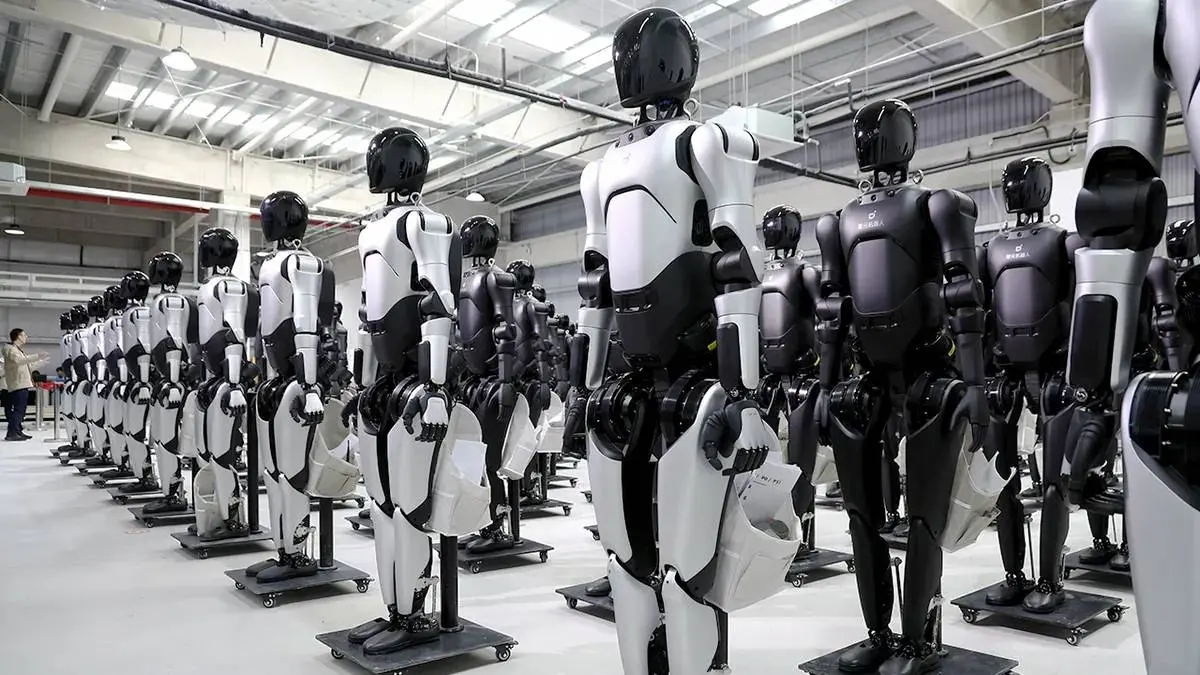
The humanoid robot space in China isn't a research experiment anymore. It's a production industry — and it's scaling fast. TrendForce just released figures showing Chinese humanoid robot output is on track for 94% year-on-year growth in 2025. That's not a rounding error. That's an industry hitting its stride.

Summary:
- TrendForce projects China's humanoid robot output will grow 94% year-on-year in 2025, marking a shift from R&D-focused development to commercial-scale production
- Unitree Robotics and Agibot together are expected to hold nearly 80% of total market shipments, with both companies demonstrating strong mass production capability
- Unitree's humanoid robot revenue surpassed quadruped robot revenue for the first time in 2025 — accounting for over 51% of total revenue — with a combined gross margin of 60%
- Agibot shipped its 10,000th Expedition A3 robot in just three months after raising its 2025 production target from 1,000 to 5,000 units
- The industry's focus is shifting in the second half of 2025 from foundational capabilities like perception and balance toward delivering measurable commercial value to end users
Two Companies Are Running Away With the Market
Unitree Robotics and Agibot. Those are the two names dominating this story right now.

Between them, they're expected to account for nearly 80% of total humanoid robot shipments this year. That's a striking level of concentration in a market that still has dozens of players competing for position.
Unitree recently filed for an IPO on China's STAR Market. The prospectus is revealing. For the first time, revenue from humanoid robots outpaced revenue from the company's quadruped robots — crossing 51% of total income. And the gross margin across both business lines sits at 60%.
That last number is the one that matters most. Robotics has long been seen as a money-burning sector. High development costs, low margins, years before profitability. Unitree is actively dismantling that narrative with real financial data, not projections.

Agibot's 10,000-Unit Milestone Tells Its Own Story
Agibot set a production target of 1,000 units for 2025. Then it raised that to 5,000. Then it hit 10,000 shipments of its Expedition A3 general-purpose robot — in three months.
That's not a company struggling to scale. That's a company that figured out manufacturing faster than its own forecasts anticipated. Shipping the 10,000th unit is a milestone, but the speed at which it arrived is the more interesting detail.
Mass production in robotics is genuinely hard. Getting humanoid hardware through quality control at volume — with the sensors, actuators, and compute required — isn't like assembling a smartphone. Agibot clearing 10,000 units this quickly suggests the production infrastructure is further along than most observers expected.
The Second Half of 2025 Is About Proving Real-World Value
TrendForce makes an important distinction in their analysis. The first phase of the humanoid robot industry was about building foundations. Perception systems. Dynamic balance. Semantic understanding. Getting the robots to work at all.
That phase is winding down. The second half of 2025 is about something harder: making robots actually useful to paying customers in real environments.
Warehouses. Manufacturing floors. Logistics operations. These are the proving grounds. And frankly, this is where a lot of humanoid robot projects have historically stalled — impressive demos, underwhelming real-world performance.
China's leading manufacturers are betting they've crossed that threshold. The production numbers suggest confidence. Whether the robots hold up under daily commercial deployment will determine if that confidence is earned.
Popular News




Latest News
Loading